
Most Philippine factory owners get quoted a price per kilowatt and stop asking questions there. That is exactly how a system ends up delivering a smaller saving than the proposal promised. A factory bill has two charges — energy and demand — and only one of them responds to solar panels. This guide explains what we size around, using three of our own Philippine factory installations: 400kW in Butuan City, 300kW for a cold storage plant in Isabela, and 100kW for a meat processing plant in Pangasinan.
Philippines Factory Solar Starts With the Demand Line on Your Bill
Philippine commercial bills break into several components, and two of them behave very differently. The energy charge is per kilowatt-hour consumed — solar removes a large slice of it. The demand charge is per kilowatt of your highest simultaneous draw in the billing month, and panels do very little for it, because your peak usually happens when a large motor starts or when a shift changeover switches on a whole line — not necessarily at noon (Blueshift Energy, 2026).
So before any sizing discussion, read the demand line. If it is a small share of the bill, a straight grid-tied array will deliver almost everything the proposal promised. If it is large, either accept that part of the bill is untouchable, or plan a battery sized for peak-shaving rather than autonomy — a different design conversation entirely.
What a Factory Load Profile Actually Looks Like
A single-shift plant is the easy case: production runs while the sun is up, so the array's output is consumed as it is made. A two- or three-shift plant is different — the evening shift runs on grid or on a battery, which is why we size the array to the daytime load and the storage to the shift pattern, never the other way round.
Motor loads dominate industrial sites: compressors, chillers, extruders, milling lines. Every one of them draws 3–7 times its running current on start, and the electrical infrastructure — not just the inverter — has to be specified for that surge. This is also where Philippine conditions bite hardest: voltage sag on a weak provincial feeder plus a large motor start is a combination we design the protection scheme around.
Grid-Tied or Hybrid for a Plant That Cannot Stop?
For pure bill savings, grid-tied wins: our Philippine price guide puts commercial payback at 2–4 years and industrial at roughly 3.1 years on average. The grid charges nothing extra for a power cut you were not using solar during anyway.
The calculation changes when a stop costs money. A cold store that warms above temperature, a batch that spoils mid-process, or a line that has to be purged and restarted can cost more in one afternoon than the battery costs over its life. Adding storage typically stretches payback by 1–2 years and removes that exposure. Excess energy, where the utility accepts it, is credited at the blended generation rate of about ₱9.25/kWh against a retail rate around ₱14.83/kWh — which is one more reason we size for self-consumption rather than export.
Three Real Factory Installations: 400kW, 300kW and 100kW
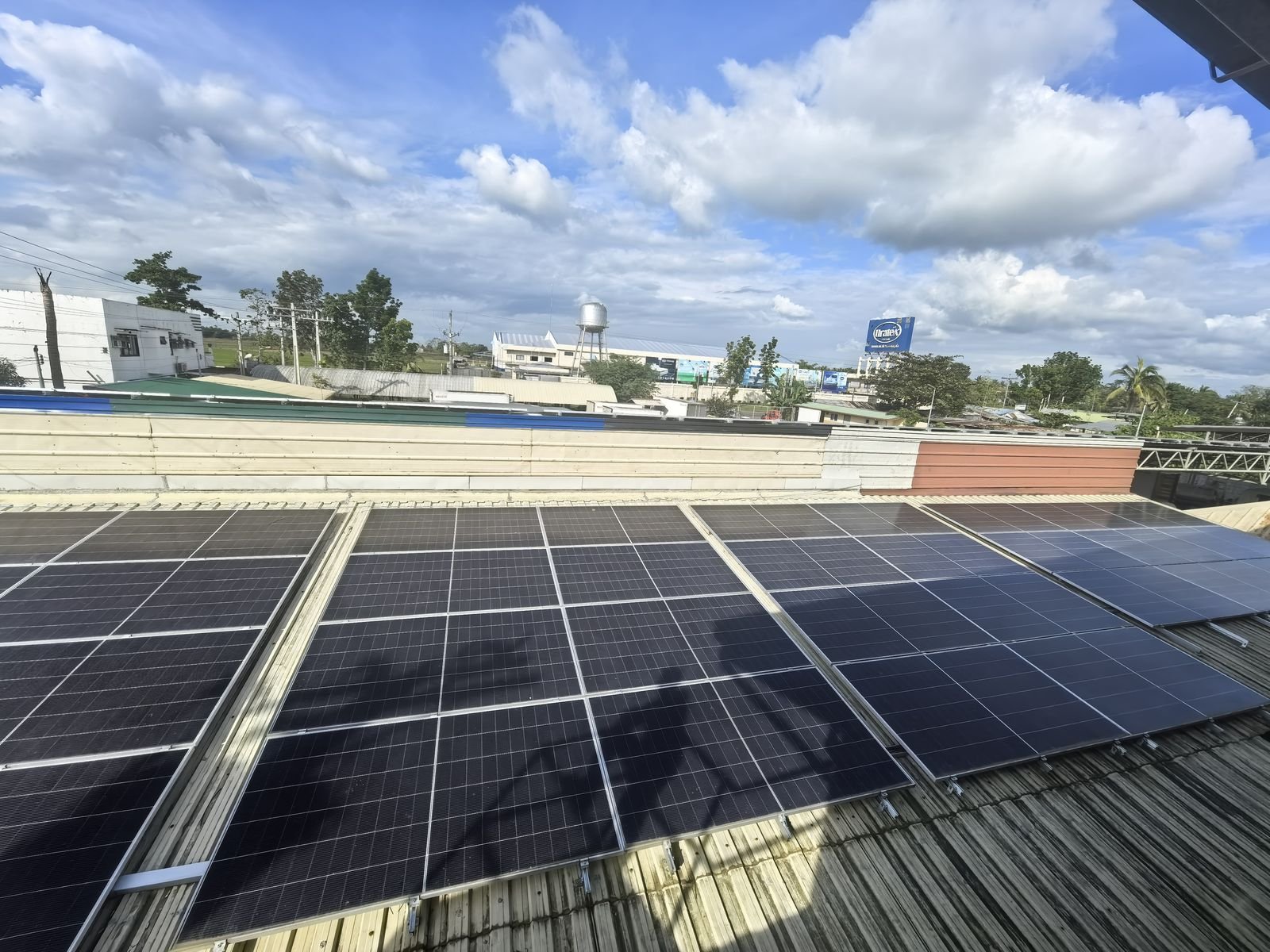
These are our own crews, our own equipment, photographed during installation in 2026.
| Project | Size | Application | Roof |
|---|---|---|---|
| Butuan City, Mindanao | 400kW rooftop | Factory | Metal deck |
| Isabela Province, Luzon | 300kW grid-tied | Cold storage factory | Metal roof |
| Pangasinan Province, Luzon | 100kW grid-tied | Cold storage & meat processing | Metal deck |
The Isabela plant runs refrigeration around the clock, so the array was sized to the daytime base load and the control strategy prioritises keeping the compressors supplied directly from solar. Cold stores are forgiving in one way — they tolerate short interruptions — and brutal in another: a longer outage has a hard, escalating cost.


The Pangasinan plant is a good example of right-sizing rather than maxing out the roof. The building could take far more than 100kW; the daytime load could not use it. Every unselfconsumed kilo-watt-hour would have been exported at roughly 60% of its retail value, so the correct array was the smaller one.
Roof and Structure: What a Philippine Factory Roof Must Survive

Typhoon exposure is the design case that separates a Philippine roof from a temperate one. Wind uplift at the array perimeter, clamp torque, and the span between rails all follow from the site's wind zone, not from a catalogue default. On metal deck roofs we fix to the purlins with the correct clips and seal every penetration; on concrete roofs, ballasted or anchored frames each have different waterproofing consequences.

Indoor equipment needs the same seriousness: ventilation, clearances, and protection coordination with the factory's existing switchgear. This room carries the plant's hybrid inverters and battery bank, sized for the loads that must ride through an outage rather than the whole plant.
Permits and Timeline: What Changed in April 2026
We documented the full net metering timeline in our Philippine price guide. In short: LGU electrical permits and the CFEI within 3 working days, utility review within 10 working days with deemed approval if missed, and the commercial capacity ceiling lifted from 100kW to 1MW. These rules have moved more than once between 2025 and 2026, so confirm the current position with your distribution utility before you commit to a design that depends on export credits.
Where the Numbers Land
Our Philippine price guide quotes grid-tied systems at ₱33,500–38,000 per kW installed in Metro Manila, so a 100kW plant runs ₱4.5M–6.5M turnkey. For factories, adjust three things: the roof type (metal deck is faster and cheaper than concrete), the distance from the inverter room to the array, and whether storage is in scope. Then check the demand line before you sign anything — it is the single most common reason a projected saving does not appear on the actual bill.