
Quick answer: factory solar power system
A factory solar power system pays back on three lines, not two: energy self-consumption, demand charge reduction, and avoided downtime. In 2026 the factory solar power system we ship most often to plants in our markets is an array sized to daytime load plus a battery sized to a named list of critical machines — extruders, kilns, cold chain, PLC and SCADA — rather than to the whole plant. Storage sized to the machines you cannot afford to stop typically lands inside the 35–50% share of system cost that industrial budgets expect, and it is the part of the system that addresses downtime at all.
What an hour of stopped production actually costs
Published benchmarks for unplanned downtime in general manufacturing run to hundreds of thousands of dollars per hour, with automotive plants quoted far higher. Those are North American and European figures for high-value continuous process, and they do not transfer directly to a factory in Ibadan or Cebu. The method transfers; the number does not. So build your own from three inputs:
Output value per hour = annual output value ÷ annual production hours
Margin lost per hour = output value per hour × gross margin
Worked with numbers you should replace. Assume a plant doing $12M a year across 4,000 production hours at a 25% gross margin, and a two-hour interruption:
| Cost line | How to estimate it | Illustration |
|---|---|---|
| Lost margin on stopped output | ($12M ÷ 4,000 h) × 25% | $750/h × 2 h = $1,500 |
| Scrap and rework | In-process material lost per event | $600 |
| Restart and re-qualification | Engineering hours to purge, clean and re-qualify the line | $450 |
| Idle labour | Operators paid while not producing | $300 |
| Diesel, if the genset carries it | kW × hours × $0.28–0.45/kWh | 200 kW × 2 h = 400 kWh → $112–180 |
| Total for one two-hour event | ≈ $2,960–3,030 |
At one event a month that is roughly $36,000 a year, which is why a factory solar power system is rarely justified on tariff savings alone — and note that the downtime clock does not stop when power returns. Restart, re-calibration and scrapped product routinely extend the true cost well past the interruption itself. If your process is continuous, high-value or temperature-held, your number will be materially higher than the illustration. Fill in your own before you decide anything: no factory solar power system should be quoted before that number exists.

Images on this page are illustrative renders rather than photographs of a specific client installation. The as-built figures in the tables come from our own project files.
The three savings, and which one gets missed
One: energy. Self-consumed solar displaces grid kWh at your tariff. In the Philippines that is around $0.156/kWh. In Nigeria it is around $0.049/kWh, which is why bill savings alone rarely carry a Nigerian project.
Two: demand charges. Where your utility bills on peak kW, a battery that shaves the top of your demand curve earns money every month regardless of how many kilowatt-hours it cycles. This is often the single most under-modelled line in a factory solar power system proposal.
Three: avoided downtime. The line most proposals omit entirely, because it requires the plant to quantify its own interruption cost. Do that arithmetic and the storage question usually answers itself.

Power quality: most of the problem is inside your building
This is where a factory solar power system earns money that no spreadsheet of tariffs will show. Power quality events reach a factory solar power system from two directions, and the split is not what most plant managers expect: somewhere between 80% and 90% of power quality problems originate inside the facility itself.
From the grid: voltage sags from faults, weather, utility switching operations, and load changes from neighbours on the same feeder.
From your own floor: large motor starts — an induction motor can draw around six times full-load current across-the-line, which drops voltage for everything else on the bus; variable frequency drives and other non-linear loads generating harmonics; welding equipment creating transients; capacitor bank switching; and ageing or poorly bonded earthing.
Why this matters for sizing:
- A sag of 10–20 milliseconds is enough to trip a PLC, reset an HMI or fault a drive — and halt an entire line. Precision processes are the most exposed, but ordinary packaging and conveying lines fault the same way.
- Harmonic distortion costs energy and equipment life. Published industrial surveys put harmonic losses at 3–10% of facility energy, and transformers exposed to around 20% total harmonic distortion can see expected life fall from 30–35 years to 15–20.
- The events are too short to see. They are sub-cycle, they may not flicker a light, and they often leave nothing in the equipment fault log beyond "no fault found".
The practical consequence for a factory solar power system is that the fix belongs at your bus, not in a complaint to the utility. If you have unexplained PLC resets, drives tripping without overload, or the same components failing repeatedly, log the events before you size anything — a power quality monitor at the service entrance and near critical equipment will tell you whether you are buying storage or buying filters.
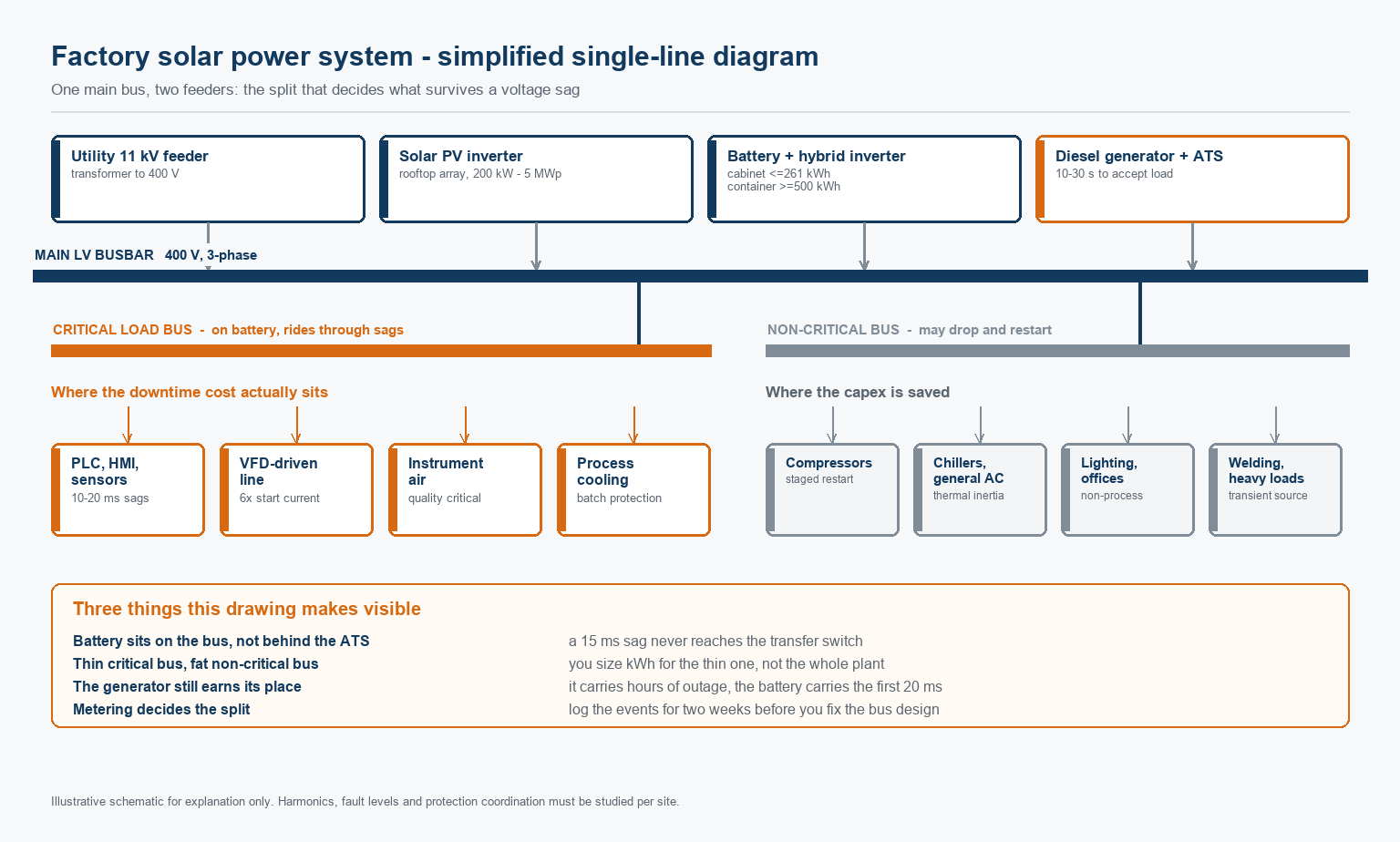
What storage fixes that a generator does not
Every industrial site has a standby generator, and every factory solar power system proposal meets the same objection: we are already covered. For a factory, the answer is about event duration.
A generator starts in 10–30 seconds and needs an automatic transfer switch. That covers a long outage well, which is why a factory solar power system with storage is not a redundant purchase. It does nothing for the millisecond-scale events that cause most trips, because the genset never starts for them — by the time it is up, the line has already stopped and the restart clock is running.
In a factory solar power system the hybrid inverter is a fast voltage source sitting on the bus. It holds voltage through sags, and transfers to island in under 20 milliseconds. That covers both classes of event: the two-second one that would otherwise scrap a batch, and the two-hour one that would otherwise idle a shift. On top of that, the same battery does peak shaving and solar self-consumption every day it is not riding through an event.
On cost, diesel generation lands around $0.28–0.45 per kWh once fuel, maintenance and allocated overhaul are counted, against roughly $0.032–0.043 per kWh for stored battery energy across its warranty life — the throughput arithmetic is set out in our battery storage cost per kWh guide. In Nigeria, where the gap between grid tariff and diesel is widest, that comparison is the whole business case.
Sizing from the machine list, not the roof
In a factory solar power system, roof area is a constraint check. The design input is the machine list, sorted by what happens when it stops:
| Load class | Examples | Treatment |
|---|---|---|
| Process-critical | Extruders, kilns, cold chain, CNC spindles, PLC and SCADA | Backed up. Interruption is not an option. |
| Quality-critical | Coating, welding, batching, weighing, labelling | Backed up — a stop scraps the batch, not just the minutes. |
| Restart-costly | Long warm-up, purge or re-qualification cycles | Backed up, or specify controlled shutdown so restart is clean. |
| Deferrable | Compressors with receiver capacity, pumps with buffer tanks, batch mills | Shed by priority. Storage can be smaller because these wait. |
| Never back up | Space heating, non-essential lighting, yard lighting | Excluded from the island bus entirely. |
Run the same arithmetic as any factory solar power system design — usable kWh ÷ backed-up kW = runtime — but run it per class. Two hours on process-critical and quality-critical is a very different battery from two hours on everything, and the difference is usually where a marginal project becomes a viable one. Our commercial sizing guide walks the load-to-kWh sequence in full.
Sizing a factory solar power system by market
A factory solar power system is designed against the local tariff and outage pattern, never against a global template:
| Market | What drives the business case | What it pushes the design towards |
|---|---|---|
| Philippines | Commercial tariff around $0.156/kWh; demand charges matter on many contracts; typhoon exposure | Array to daytime load plus storage on critical process loads and peak shaving. Shift patterns are worked in our Philippines factory solar guide |
| Nigeria | Tariff around $0.049/kWh, so bill savings are weak; the case runs on diesel displacement and continuity | Diesel-first model. See our diesel versus solar cost analysis for Nigeria and the Nigeria factory sizing guide |
| Kenya / Ghana | Commercial tariffs around $0.171 and $0.175/kWh | Standard self-consumption plus backup; model both lines |
| Central America | The highest tariffs in our set — roughly $0.172/kWh in the Dominican Republic to $0.229–0.255/kWh in Costa Rica; high humidity and coastal salt exposure | Self-consumption carries more of the case; specify IEC 61701 salt-mist certification on coastal sites |
| Middle East | Very low tariffs — Qatar around $0.036/kWh; the driver is self-consumption and reliability in extreme heat | Prioritise temperature behaviour and soiling. See solar panels in Middle East heat |
Tariff figures: GlobalPetrolPrices, December 2025. Power quality figures: published industrial power quality surveys and Schneider Electric (2026-07). Plant-level interruption costs must come from your own records — every illustration on this page uses assumed inputs.

What a factory solar power system quote must state
Eight items belong in every factory solar power system quote. All of them are cheap to specify at design stage and expensive to discover after commissioning:
- Usable kWh at a stated depth of discharge. Not nameplate. A 215 kWh bank at 80% DoD delivers about 172 kWh.
- Continuous and surge kW of the island bus — checked against motor starting current, not steady-state kW.
- Ride-through and transfer time in milliseconds. Ask for the measured figure, not "seamless".
- Which machines sit on the backed-up bus. A single-line diagram before signature, so scope is a drawing rather than a conversation.
- Peak-shaving behaviour. The demand target, and how the controller enforces it.
- Cycle life and term, together. 6,000 cycles at 80% DoD or 10 years, whichever comes first.
- Harmonic behaviour. Whether the power conversion system filters, adds to, or is neutral to your existing distortion.
- What is excluded. Switchgear, civil works, permits and generator integration — the lines that most often move after signature.
FAQ: factory solar power system
How do I size a factory solar power system?
Does solar really reduce downtime, or only the bill?
Can we keep running when the grid fails?
What causes voltage sags in a factory?
Will harmonics from our drives damage the new system?
How much does a two-hour outage actually cost a plant?
Is a factory solar power system worth it where the tariff is very low?
Does storage also cut our demand charges?
What cooling does an industrial battery need?
Where can I see full system prices and a plant example?
Get a plant-specific design
Send your machine list with what must stay running, your last twelve months of bills with the demand charges, and your interruption history. We will return a factory solar power system design with the load classes, the usable kWh, a landed cost and a three-line payback — usually within 24 hours.