
Quick answer: 100kw 215kwh battery storage
The 100kW is a power ceiling and the 215kWh is an energy budget. They fail in different ways, which is why two sites with the same unit can get four hours or forty minutes. A 100kW/215kWh battery storage system will carry roughly 50kW of mixed commercial load for three to four hours, a 40kW cold room for about four and a half hours, or a single 60kW production line for just under three. It will not carry a 300kW factory, a 60kW chiller with a hard start, or three welding sets at once — and that is a property of the rating, not of the brand.
What a 100kW/215kWh battery storage system does cover, in the order most buyers care about: guest-room air conditioning, cold storage, water pumping, front-desk and POS systems on the hotel side; PLC and drives, instrument air and process cooling on the plant side. Every one of those is a named load with a measured kW, not a share of a monthly bill. Sizing from the bill is how a 100kW/215kWh battery storage system ends up either half-empty or tripping on the first hot evening.
What the 100kW and the 215kWh each limit
Two numbers on the same datasheet govern two different failure modes. Buying a 100kW/215kWh battery storage system without separating them is the most common configuration error we see.
| Rating | What it governs | How it fails when exceeded | What to check on the quote |
|---|---|---|---|
| 100kW continuous | How much load can run at the same instant, including starting surges | Inverter overload trip, then a full outage of the backed-up bus | Continuous kW and surge rating, against motor starting current |
| 215kWh nameplate | Total energy available between charges | Runtime ends early, quietly, with no fault code | Usable kWh at a stated depth of discharge |
| 172kWh usable | The 215kWh × 80% depth of discharge | Designing to 215kWh and promising hours you cannot deliver | Whether the supplier quotes nameplate or usable |
| Start multiplier | Peak current for one to three seconds on motor start | Trips on start-up while steady-state looks fine | Largest single motor, and whether it starts under load |
A 100kW/215kWh battery storage system sized only against the kW column will pass a steady-state check and still trip, because a 12kW compressor can pull three times its running current for two seconds. The unit did not fail on energy. It failed on power, for two seconds, and took the whole bus with it.

The photographs on this page are illustrative renders rather than pictures of a specific client installation. The runtime chart and the specification figures are ours.
The load list, by starting current
This is the table to fill in before anyone quotes you. Running kW sets the runtime; starting current decides whether the unit can hold the load at all. Both columns belong to the same 100kW/215kWh battery storage system.
| Load class | Typical running kW | Start multiplier | Surge kW | Hours alone on 172kWh |
|---|---|---|---|---|
| Guest-room air conditioning, 10–12 splits | 30 | 2–3× | 60–90 | 5.7 |
| Cold room, two compressors | 12 | 3× | 36 | 14.3 |
| Rice mill line, motors and drives | 60 | 2.5× | 150 | 2.9 |
| Deep-well pump | 11 | 3–4× | 33–44 | 15.6 |
| PLC, POS, lighting, IT | 5 | 1× | 5 | 34.4 |
| Arc welding set | 15 | 2× transient | 30 | poor fit |
Read the mill row twice. The running load fits comfortably inside 100kW, and the start surge does not — 150kW against a 100kW ceiling. A 100kW/215kWh battery storage system can still run that mill, but the drives have to be started in sequence, or on soft starters, so the surges never overlap. That is a commissioning instruction, not a bigger battery.
Welding is the other row worth pausing on. An arc welder draws a ragged, rapidly changing load that a hybrid inverter handles badly on an island bus. If welding has to continue through an outage, it belongs on the generator, not on the battery.

Runtime arithmetic for a 100kW/215kWh battery storage system
Runtime = usable kWh ÷ backed-up load kW
Usable kWh = 215 × 0.80 = 172 kWh
Three worked cases on the same unit. At 48kW of mixed hotel load — rooms, cold storage, front desk — a 100kW/215kWh battery storage system gives 172 ÷ 48 = 3.6 hours. At 30kW, the rooms and lighting only, it gives 5.7 hours. At 80kW, two lines plus utilities, it gives 2.2 hours. Same hardware, three different answers, and none of them is "four hours" as a general claim.
Two derates sit inside that arithmetic and both are cheap at design stage:
- Usable is not nameplate. 215kWh at 80% depth of discharge is 172kWh. Depth of discharge, not capacity, is what a 10-year warranty is written against — this cabinet is rated 6,000 cycles at 80% DoD.
- Surge is not steady state. Size the inverter against the largest starting current on the bus, not against the sum of running kW. A 100kW/215kWh battery storage system with a 60kW chiller on it needs the chiller's start method resolved before delivery.
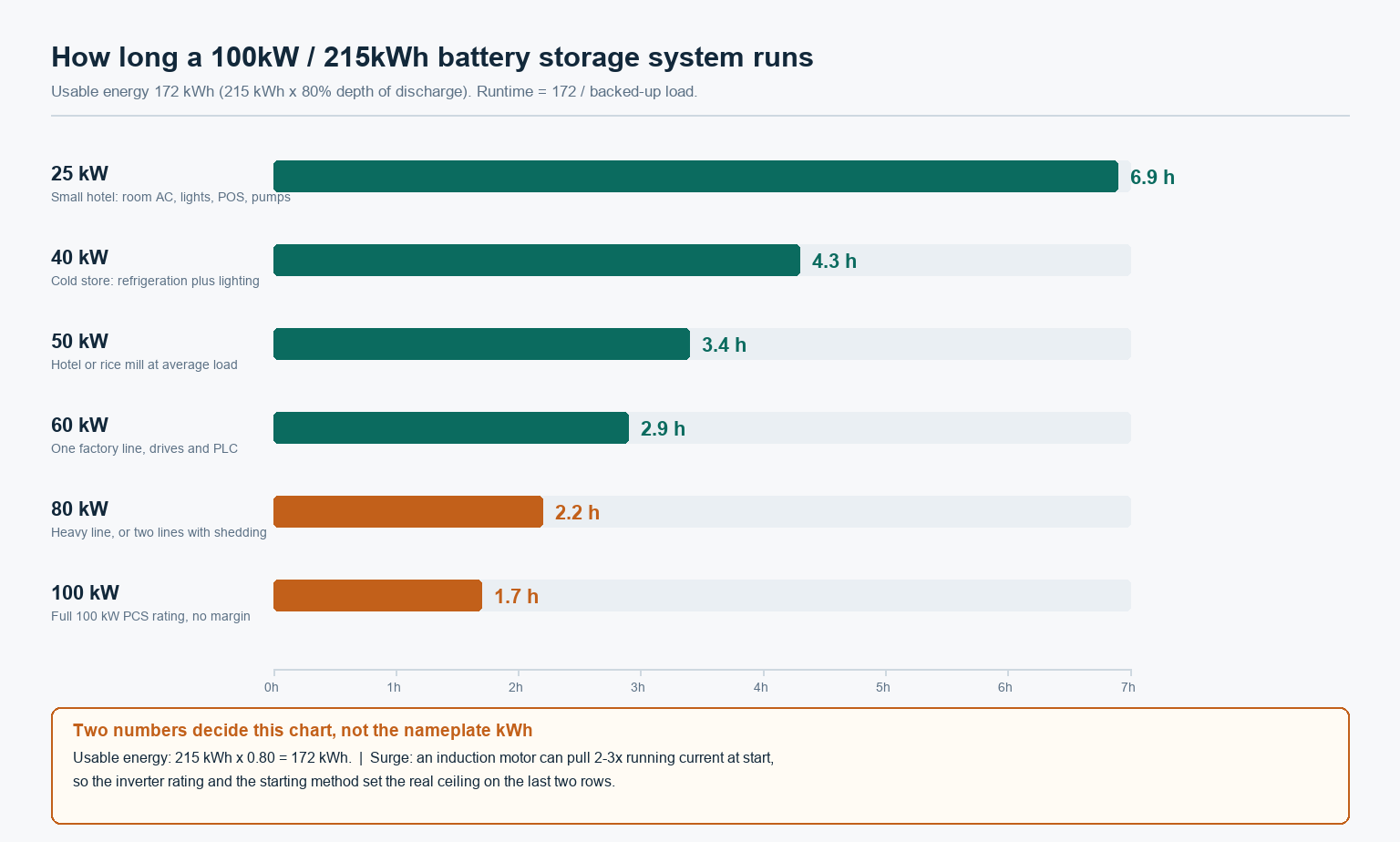
Notice the shape of that chart. Runtime is linear in load, so doubling the load halves the hours — which is why "how many hours does it last" has no answer without a load figure attached. Every honest quote for a 100kW/215kWh battery storage system starts with a kW number the buyer supplied.
Three duty cycles: hotel, cold store, rice mill
The same 100kW/215kWh battery storage system behaves very differently across three applications we ship regularly. What changes is not the hardware but which loads are on the bus and how often the unit cycles.
| Application | Backed-up load | Runtime | Cycles per day | Deliberately excluded |
|---|---|---|---|---|
| 60-room hotel | 45kW — rooms, cold storage, front desk, pumps | 3.8 h | 1 | Laundry, pool plant, public-area AC |
| Cold store, 800m³ | 35kW — compressors, lighting, dock | 4.9 h | 1–2 | Dock refrigeration during defrost cycles |
| Rice mill, single line | 65kW — mill, blowers, conveyors, PLC | 2.6 h | 1 | Drying equipment, workshop welding |
The cold store cycles twice because refrigeration runs overnight as well as by day; the hotel cycles once because its peak is an evening block. That difference matters for warranty life. At one cycle a day, 6,000 cycles is roughly sixteen years of service — longer than the ten-year term, which is why the term binds first.
What it will not power
Being explicit about the ceiling is more useful than another efficiency claim. A 100kW/215kWh battery storage system is not a whole-site solution for most factories, and buyers who expect that end up disappointed at commissioning rather than at quotation.
- A 300–400kW plant. A 100kW/215kWh battery storage system can back a critical bus inside that plant, but not the plant. Whole-site backup needs parallel units or a containerised system from 500kWh.
- A hard-starting chiller. A 60kW screw chiller drawing three times running current needs 180kW of surge. Either the start method changes or the inverter class does.
- Simultaneous welding and motor starts. The two worst load shapes on one island bus. Stagger them or keep welding on the generator.
- Multi-day autonomy without solar. 172kWh is a buffer, not a season. Two cloudy days need either a larger bank or a generator handover — for how mini-grid operators size that buffer, IRENA's 2026 West Africa storage assessment is the reference we use.

Pairing it with a 100kWp array
The unit is usually sold with a matching array, and the numbers line up by design: about 100kWp of TOPCon modules produces roughly 420–460kWh a day in good sun, against a 215kWh battery. The array fills the battery; the battery covers the evening, the outage and the peak.
What that means in practice is that a 100kW/215kWh battery storage system paired with its own array cycles once a day under normal operation and switches to backup duty without warning when the grid drops. The same hardware does self-consumption on ordinary days and continuity on bad ones, which is why the payback argument differs so much between markets — diesel displacement in Nigeria, demand charges in the Philippines, self-consumption in the Gulf.
When 100kW/215kWh is the wrong unit
Three conditions push you off this size, and all three are visible before you order:
| Condition | What it looks like | Next step |
|---|---|---|
| Continuous load above 100kW | Two production lines, or a plant with 150kW of running load | Parallel two units, or step up to the 125kVA class |
| Longer runtime at 50kW | Caribbean hurricane exposure, 8–12 hour design | Second cabinet, or the 261kWh class in the same family |
| Multi-megawatt site | Cold chain hub, mine, 6MW factory | Containerised system from 500kWh with liquid cooling |
Note the cooling boundary while you are sizing: cabinet systems up to 261kWh are air-cooled as standard, and containerised systems from 500kWh use liquid cooling to hold cell temperature spread within 2°C. A 100kW/215kWh battery storage system sits firmly on the air-cooled side of that line, which is why it installs outdoors on a pad rather than in a plant room.

What the quote must state
Seven lines, all of them cheap to specify and expensive to discover afterwards:
- Usable kWh at a stated depth of discharge. For this unit, 172kWh at 80% DoD — not 215.
- Continuous and surge kW. Both numbers, with the surge duration in seconds.
- The largest motor you intend to start. Name it, with its starting method.
- Which circuits sit on the backed-up bus. A single-line diagram before signature, so the scope is a drawing rather than a conversation.
- Transfer time. Under 20ms for the inverter, against 10–30 seconds for a generator with an ATS.
- Cycle life and term together. 6,000 cycles at 80% DoD or ten years, whichever comes first.
- What is excluded. Switchgear, civil works, permits, and the generator integration.
A 100kW/215kWh battery storage system quoted CIF $88,000–115,000 to Lagos or Manila, with the battery block itself at $140–185 per kWh of the delivered figure, should come with all seven in writing. If two suppliers quote the same headline number and different usable kWh, they are not quoting the same system.
FAQ: 100kw 215kwh battery storage
How many hours does a 100kW/215kWh battery storage system last?
How much of a 215kWh battery is actually usable?
Can it run a whole factory?
Will it start an air conditioner or a compressor?
Can two units be paralleled?
Does it work with an existing diesel generator?
How much solar does it need?
Is air cooling enough where we are?
How long will the battery last?
What does a 100kW/215kWh battery storage system cost?
Get your load list checked against this unit
Send the machine list — running kW, the largest motor, and what has to stay on — and we will return a 100kW/215kWh battery storage system configuration with the load classes, the usable kWh per class, a CIF figure and a payback range, usually within 24 hours. If the unit is the wrong size for your site, the answer will say so and name the next size up.