
The two numbers that decide solar panels Middle East heat performance never appear on the nameplate: midday cell temperature, which erodes 12–20% of rated power, and dust, which costs a further 3–6% of annual yield when cleaning is unscheduled. Both are recoverable at the specification stage — low temperature-coefficient n-type modules, a 30-day cleaning interval, and inverters de-rated for 50 °C ambient hold a Gulf commercial plant at a performance ratio in the low-to-mid 70s rather than the 60s.
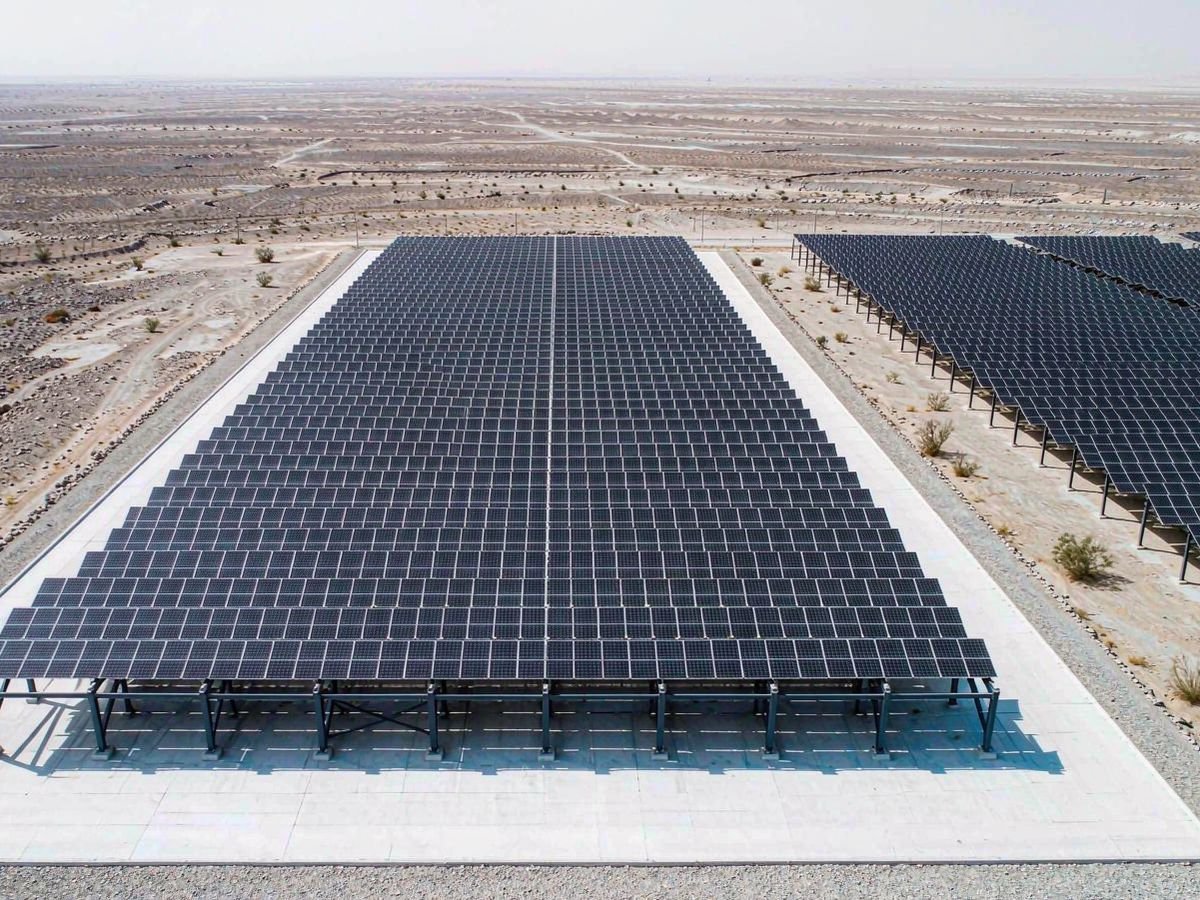
Solar Panels Middle East Heat: STC, NOCT and the Gap Nobody Budgets For
Every datasheet opens with a flash-test figure taken at Standard Test Conditions: 1,000 W/m², 25 °C cell temperature, AM1.5 spectrum. Those conditions do not exist outdoors in the Gulf, where cell temperature drives voltage and a module at 25 °C is running colder than the air around it.
NOCT (Nominal Operating Cell Temperature), measured under IEC 61215 at 800 W/m², 20 °C ambient and 1 m/s wind, is the honest anchor. A 45 °C NOCT module in 45 °C air settles well above 60 °C in the afternoon, and 70–75 °C is routine on calm, high-irradiance days. Arrays sized on the nameplate under-deliver on the meter.
Temperature Coefficient: The Arithmetic That Decides the Array Size
The power temperature coefficient states the loss per degree of cell temperature above 25 °C. Mainstream crystalline silicon sits between roughly −0.29%/°C and −0.40%/°C, and that spread is worth real money. A 600 W module at 70 °C is a 45 °C rise: at −0.29%/°C it loses about 13% (roughly 522 W), at −0.40%/°C about 18% (roughly 492 W). Same nameplate, same roof, 6% apart for the life of the plant.
Two corrections keep this honest: desert sites can exceed 1,000 W/m² and push output back above the flash-test number, and a cool morning can briefly beat nameplate. Annually, heat dominates — performance ratios for Gulf projects typically land in the 72–77% range.
Sand Soiling: The Loss You Can Actually Manage
Dust is the variable you control. Gulf dust is coarse, deposits fast, and rarely gets washed off by nature; much of the region sees only 50–100 mm of rain a year. Field studies put annual soiling losses for uncleaned Middle East arrays at roughly 3–6% — but that is an average. In one Saudi 100 MW plant, seasonal loss has been measured from about 2% in the cleanest month to about 16% in the dustiest. Regional O&M experience is that washing at intervals not exceeding 30 days holds soiling below 2%; much longer intervals can escalate losses toward 40% in severe seasons.
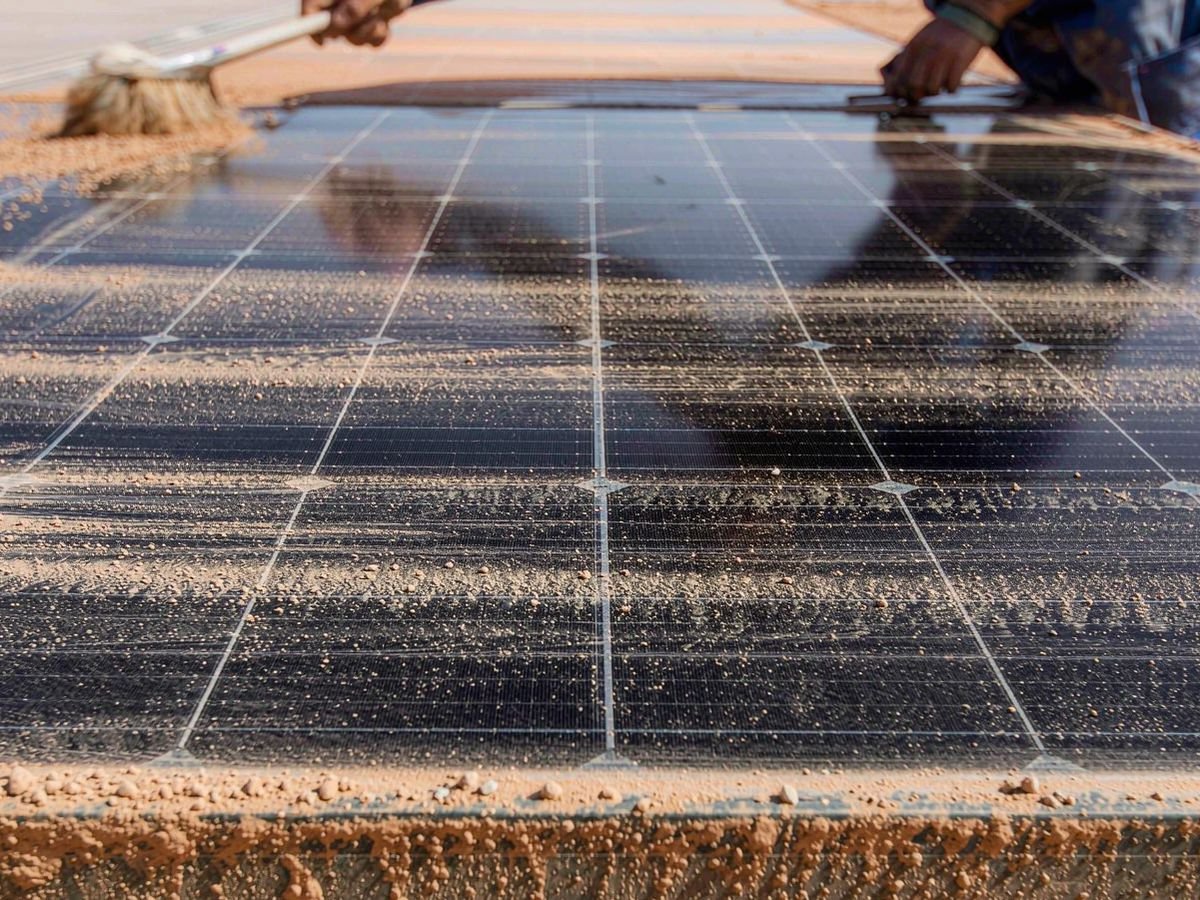
Sizing solar panels Middle East heat and dust strategy together means accepting that the yield curve follows the cleaning calendar. Clean early morning or evening, because cold water on hot glass causes thermal shock. Wait for a sandstorm to pass rather than washing while dust is still airborne. And treat uneven soiling as a defect: a strip of caked dust along the lower frame drives shaded cells into reverse bias, and the resulting hot spots can permanently damage the module.
| Cleaning method | Water use | Realistic interval (Gulf C&I) | Strengths | Watch-outs |
|---|---|---|---|---|
| Manual dry brush | None | 7–15 days in dusty seasons | No water logistics; works off-grid | Abrasion, dust redistribution, high labour intensity |
| Water wash, low-TDS or demineralised | Moderate | 20–30 days | Restores glass closest to clean | Water availability and cost; mineral spotting from hard water |
| Robotic or semi-automatic | None to low | 30 days or better, continuously | Repeatable, runs at dawn or night, no thermal shock risk | Capital cost; needs its own maintenance and spares |
| Anti-soiling coated glass | Reduces need | Extends any of the above | Materially lowers cleaning frequency | Coating durability; panels still require cleaning |
What is missing from that table is a universal answer: the right interval trades cleaning spend against lost generation, and it shifts month to month.
Module Choice: N-Type, Bifacial and Anti-Soiling Glass
Where solar panels Middle East heat and dust hold cells at 65–75 °C for months, the temperature coefficient stops being a datasheet footnote and becomes the selection criterion. n-type TOPCon and HJT cells sit at the low end of the coefficient range, lose less to light- and elevated-temperature-induced degradation, and resist potential-induced degradation better than older p-type PERC products.
| Cell technology | Typical power temp. coefficient | Typical first-year degradation | Annual degradation after year 1 | Hot-climate notes |
|---|---|---|---|---|
| p-type PERC (mono) | −0.34% to −0.40%/°C | 2.0–3.0% | 0.45–0.55%/yr | Highest thermal loss of the group; most exposed to LeTID |
| n-type TOPCon | −0.29% to −0.34%/°C | 1.0–1.5% | 0.35–0.45%/yr | Strong balance of cost and heat performance |
| n-type HJT | −0.24% to −0.29%/°C | 1.0–1.5% | 0.25–0.35%/yr | Best coefficient available; tighter process window |
| n-type IBC / ABC | −0.26% to −0.30%/°C | 1.0–2.0% | 0.30–0.40%/yr | Highest efficiency, highest cost per watt |
Those are typical published ranges, not guarantees — the binding number is the one in the manufacturer's flash-test and degradation report for the exact bill of materials you buy.
Bifacial modules deserve a qualified yes here. On bright desert ground and pale concrete aprons, rear-side albedo is high and the extra yield usually lands in the 5–15% range, but it depends on mounting height, row pitch and albedo — and it is measured on a rear face nobody washes. Carry it as a documented assumption, never a fixed percentage, and insist on anti-soiling front glass.
Inverters and Electrical Equipment at 50 °C Ambient
Inverter datasheets usually state maximum output at a nominal ambient of 40–45 °C, then publish a derating curve above it. In a Gulf summer the enclosure sits well above 50 °C, so the inverter curtails precisely during the highest-value hours of the day. Three questions settle selection: where the derating curve starts, the unit's temperature and altitude rating, and how the enclosure is cooled.
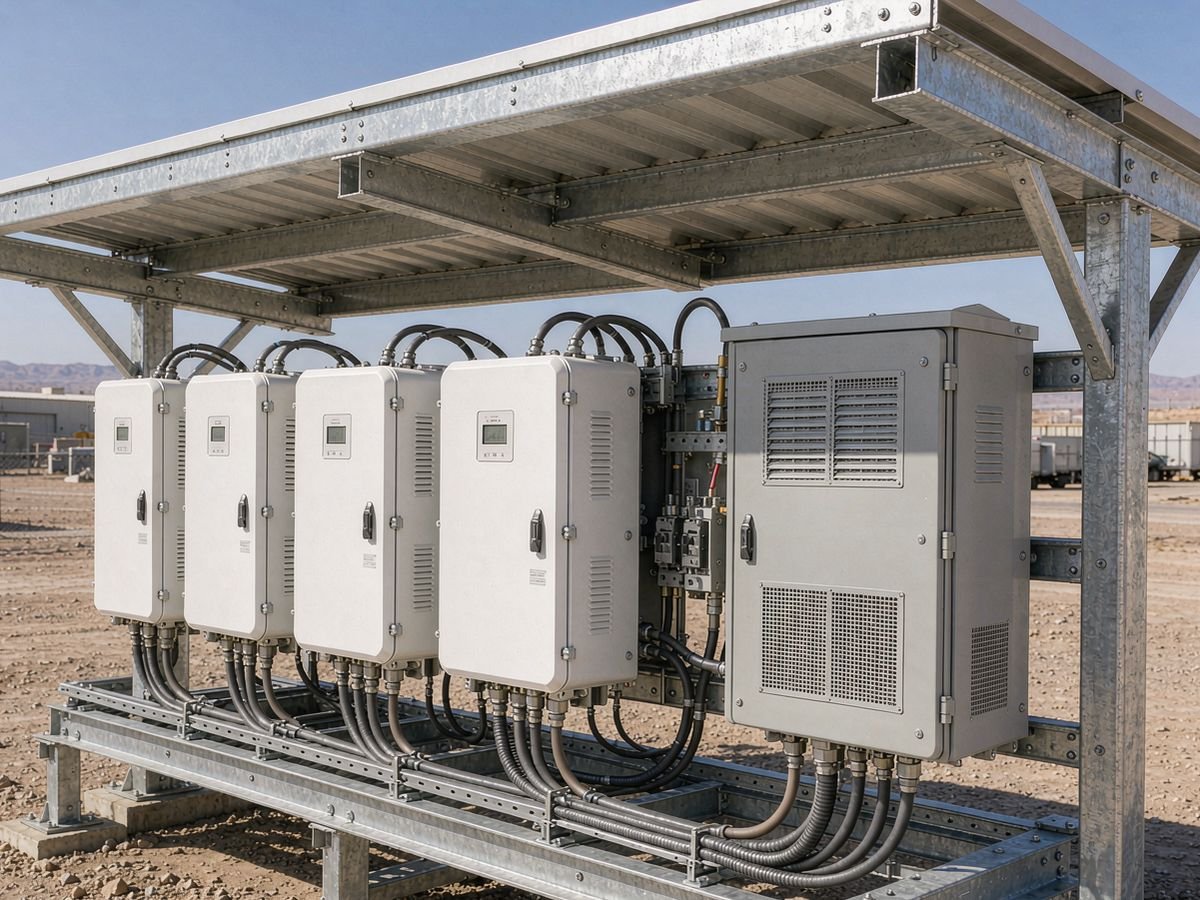
IP rating alone does not solve the desert. IP65 or IP66 resists water jets, but fine dust still migrates past aged gaskets and unfiltered vents. Direct sun on an enclosure adds 10–15 °C to the internal air, so a shade canopy with at least 150 mm of clearance, away from the western afternoon sun, buys back capacity cheaply. Seal cable entries and control condensation: the night-time dew cycle turns settled dust into a conductive crust on terminals. On the DC side, correct conductor ampacity for a 55 °C tray environment per IEC 60364-5-52 and use UV-stabilised, 90 °C-rated solar cable in trays.
Salt Fog, Blowing Dust and the IEC Standards That Prove a Panel
Coastal and inland sites are different failure modes, and both need evidence rather than adjectives. IEC 61215 covers design qualification, including thermal cycling and humidity-freeze; IEC 61730 covers safety. On top of those, specify IEC 61701 salt mist corrosion testing for coastal or humid sites and IEC 60068-2-68 blowing dust and sand testing for inland ones. Salt mist attacks frames, fasteners and junction boxes; blowing dust abrades coatings and enters every unsealed interface.
Connectors are where dust quietly becomes a fire risk. Fine particulate enters an imperfectly mated DC connector, moisture follows, and daily thermal cycling works the contact loose until resistance and joint temperature climb. Use matched connectors rated to IEC 62852, verify every crimp, and support cables so their weight is not carried by the connector. For solar panels Middle East heat and voltage duty, also require PID test evidence to IEC TS 62804-1 and light-soak data showing the product is not LeTID-sensitive at operating temperature.
Mounting Structures, Thermal Cycling and Foundations
Aluminium expands by roughly 23 × 10⁻⁶ per °C — about 4 mm across a 6-metre rail over a 30 °C day-to-night swing. Over thousands of cycles that loosens fasteners and opens joints that dust then fills. Design with slotted holes and expansion allowances, and match stainless fasteners to aluminium to avoid galvanic corrosion.
On ground-mounted plants, wind-blown sand is an abrasive that never stops working. Hot-dip galvanising to ISO 1461 with adequate coating thickness outlasts thin paint by a wide margin. In sabkha and other chloride-rich soils, use sulfate-resistant cement with a low water-cement ratio, or piling designed for the aggressive ground. Raise combiner boxes, connectors and terminations well clear of grade: the sand-carrying layer of a desert wind moves fastest in the first half metre.
The Document Pack to Demand Before You Sign
Most hot-climate underperformance traces back to a document nobody requested. Before the order, ask for the production flash-test report and the measured temperature coefficient for the delivered bill of materials rather than the marketing datasheet; NOCT or NMOT per IEC 61215; IEC 61215 and 61730 certificates; IEC 61701 salt mist at a stated severity level and IEC 60068-2-68 dust reports; PID and LeTID/light-soak results; and the inverter's derating curve against ambient temperature with its IP rating.
Then read the warranty. A degradation schedule is only as strong as its definition of warranted power — who measures it, with what instrument and uncertainty, and what the annual cap is in year 10 and year 25. Ask for anti-soiling coating durability data if that is being sold to you, and for hot-climate reference installations you can contact. Our guide to solar system certifications explained maps which certificate answers which risk.
The choices interact. A low-coefficient n-type module paired with a poorly shaded inverter gives part of the gain back, and a bifacial array with no cleaning plan never shows its rear-side benefit — our bifacial vs monofacial comparison shows when each option earns its premium. Durability is also a supply-chain question, which is why we set out how to choose a reliable solar power system supplier with a matching audit trail. Get those decisions right and solar panels Middle East heat duty becomes a managed variable rather than an annual argument.