

The photographs on this page are illustrative renders, not pictures of a specific client installation. The document diagram and the fee arithmetic are ours.
Quick answer: soncap battery storage nigeria
SONCAP clearance for battery storage in Nigeria runs on four documents, in a fixed order: a Product Certificate held offshore, a Form M opened by the importer, a SONCAP Certificate raised per shipment, and a Pre-Arrival Assessment Report generated by Customs. The first two certificates come from an inspection firm appointed by the Standards Organisation of Nigeria. The Form M and the PAAR belong to the importer and its bank.
The two certificates are not alternatives. The Product Certificate registers the product and the manufacturer. The shipment certificate releases one consignment. For a soncap battery storage nigeria file, a container arriving with a shipment certificate that does not match its packing list line by line is treated as if it had no certificate at all.
The cost is knowable in advance and it is small next to the equipment. A registered product certificate costs $1,000 and a shipment certificate costs $350. Against a 100kW/215kWh system at a CIF Lagos of $88,000–$115,000, the certification line is under one per cent of the invoice value. Demurrage on the same container runs by the day.
| Certificate or document | Fee | Validity | Who raises it | What it unlocks |
|---|---|---|---|---|
| Product Certificate, unregistered | $500 | 6 months | Appointed inspection firm offshore | A first, single consignment |
| Product Certificate, registered | $1,000 | 1 year | Appointed inspection firm offshore | Repeat shipments of the same model |
| Product Certificate, licenced | $2,000 | 1 year | Appointed inspection firm offshore | Manufacturers shipping most months |
| SONCAP Certificate | $350 | One shipment | Appointed inspection firm, before loading | PAAR and customs release |
| Form M | Bank charge | Per transaction | Importer, through an authorised dealer | The shipment certificate and the PAAR |
| PAAR | No separate fee | Per consignment | Nigeria Customs Service | Duty assessment and release |
Read the table from the bottom up if you are the importer. The PAAR is what you actually need at the port, and it is generated from documents you cannot produce yourself. On a soncap battery storage nigeria project the sequence therefore matters more than any single certificate, because each row unlocks the one above it.
What the compliance line costs, per kWh
Split the certification cost by the energy in the container and it stops looking like paperwork. Any soncap battery storage nigeria budget should start from the fixed fee per shipment rather than from a percentage of the invoice.
Compliance cost per kWh = (product certificate fee ÷ shipments covered by that certificate + $350 shipment certificate) ÷ kWh on the shipment.
One 215kWh cabinet shipped under a registered certificate that covers six consignments: ($1,000 ÷ 6 + $350) ÷ 215 = $2.40 per kWh. The same cabinet shipped alone under an unregistered certificate: ($500 + $350) ÷ 215 = $3.95 per kWh. The gap between the two routes is $1.55 per kWh, or about $333 on that container.
On a 500kWh container the soncap battery storage nigeria certification cost spreads thinner, to $0.70 per kWh before the product certificate is amortised. Certification is a fixed cost per shipment, so it rewards full containers rather than frequent small ones. That is the opposite of the instinct that says order a sample first and scale later.
Two lines sit outside this formula and both are larger than the certificates, which is why a soncap battery storage nigeria budget keeps them on separate rows. The clearing agent is quoted at ₦500,000–1,500,000 per container in Lagos. Duty and VAT are assessed on the CIF value at the rate of exchange on the validated Form M, and they are not part of the certification fee at all. A soncap battery storage nigeria budget should carry them on separate rows, so that a change in duty never looks like a change in compliance cost.
A soncap battery storage nigeria quotation that hides the certificate fee inside the equipment price is harder to compare across suppliers, and it is the first line a procurement committee unpicks.
For the equipment itself, our BESS cost and import guide for Nigeria carries the CIF ranges and the landed-cost build-up. This page stays on the documents.
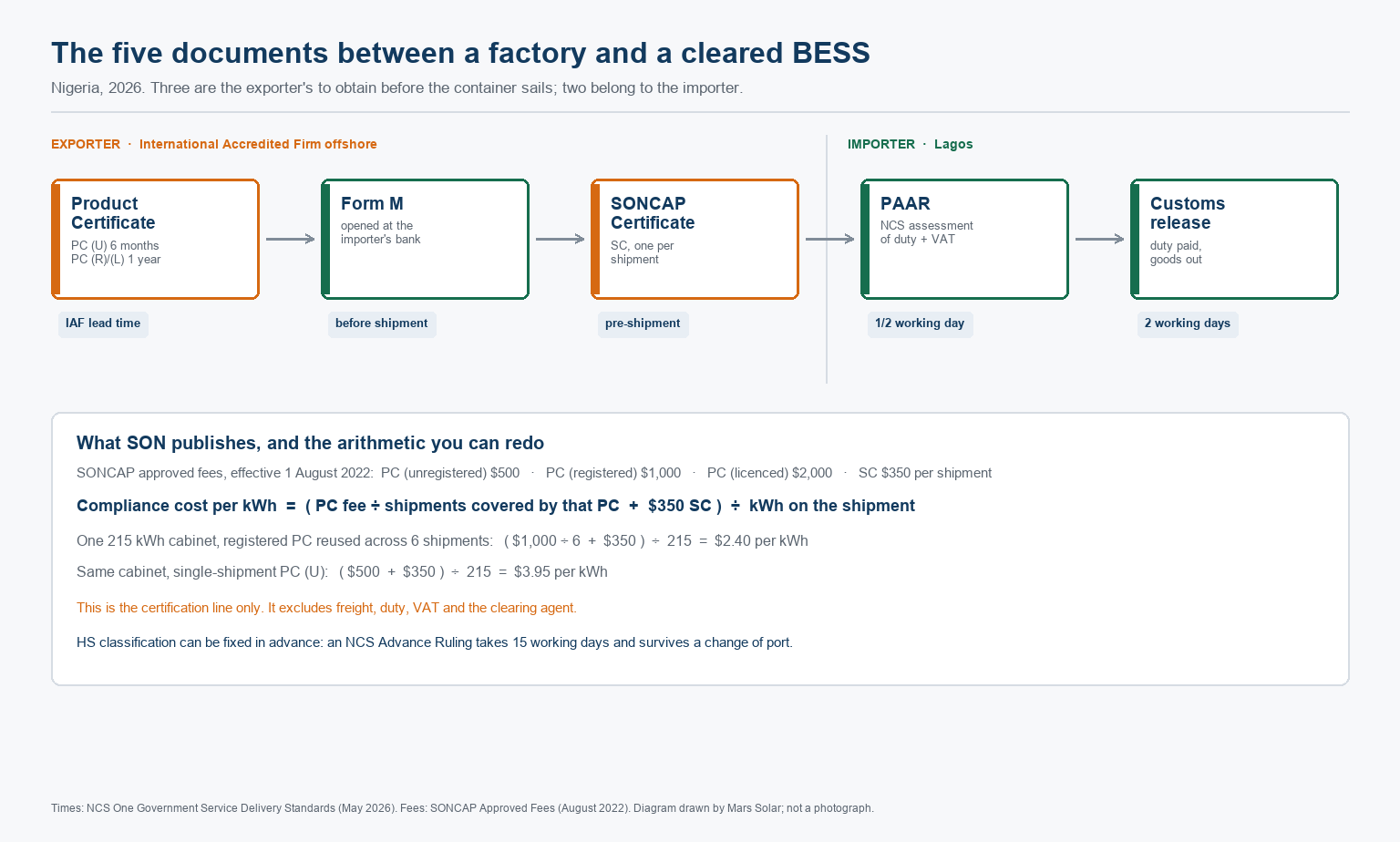
The document chain from Foshan to Apapa
A soncap battery storage nigeria chain has five documents and two owners. Three belong to the exporter and must exist before the container is loaded. Two belong to the importer and cannot be started until the first three are in hand. A soncap battery storage nigeria chain that runs in any other order runs twice.
The Standards Organisation of Nigeria appoints international accredited firms to carry out inspection, testing and certification offshore, and states in its SONCAP approved fee schedule that the certificates they issue are required for the registration of Form M and the processing of PAAR. Only product certificates issued by those appointed firms are accepted by banks for regulated products. A certificate from an unappointed body is not a cheaper route; it is not a route, and no soncap battery storage nigeria consignment has ever cleared on one.
The timeline below is drawn from published sources rather than from experience. Customs publishes half a working day for PAAR generation once a valid Form M and the supplier details are with it, and two working days to release manufactured goods. Those are service standards for a complete file. They are not a promise about an incomplete one, and a file missing a single sheet sits outside them.

Where containers actually stop
Six failures account for most of the delay on soncap battery storage nigeria shipments, and none of them is technical. They are mismatches between documents that were correct in isolation, produced by people who each believed the other party owned the step.
- The product certificate names a model number that the invoice spells differently. The shipment certificate is issued against the product certificate, so the error propagates.
- The HS code on the Form M is the one the supplier used for its Chinese export declaration, not the one Nigeria assesses. Reclassification at the port means re-assessment.
- The shipment certificate is applied for after the container is loaded. The inspection is a pre-shipment inspection, and there is nothing to inspect once the doors are sealed.
- The certificate is issued but never activated, so it does not appear against the importer record when the PAAR is generated.
- The packing list counts cabinets while the invoice counts modules, and the values no longer reconcile.
- The technical file arrives as a photograph of a certificate rather than the certificate, and the inspection firm cannot close its review.
The pattern behind all six soncap battery storage nigeria failures is that the importer treats the certificate as something the supplier sends, and the supplier treats it as something the importer arranges. Both are wrong. The exporter contracts the inspection firm, while the importer activates the certificate and opens the Form M.
An unresolved mismatch does not produce a fine at the gate. It produces a container that cannot be entered for assessment, sitting at a terminal that charges by the day, against an installation crew that has already been mobilised. On a 100kW system the storage alone is $88,000–$115,000 CIF. A soncap battery storage nigeria shipment that loses two weeks to demurrage on that value has erased the margin the project was costed against.
HS classification: settle it before Form M
For soncap battery storage nigeria, the tariff line is chosen once and then inherited by every document downstream. Lithium-ion accumulators sit under HS 8507.60. A containerised system with integrated conversion can also be entered under 8504.40 as a static converter. Which one applies depends on how the unit is built and how it is declared. The difference is not cosmetic, because the heading decides the duty rate and the documents that attach to it.
Customs offers a way to settle the question before money moves. An Advance Ruling on tariff classification, origin or valuation takes 15 working days, and it requires a detailed product description, the manufacturer data sheet or safety data sheet, and a sample where applicable. Fifteen working days is a fraction of a stalled container, and a ruling obtained once keeps working after the port or the agent changes. It is the cheapest insurance in the whole soncap battery storage nigeria process.
For a battery cabinet the application is straightforward: the datasheet, the single-line diagram, the bill of materials by module, and a statement of what the unit does when the grid is absent. That last item is what separates a battery from a converter in the eyes of an assessor, and it is the item most soncap battery storage nigeria applications leave out.
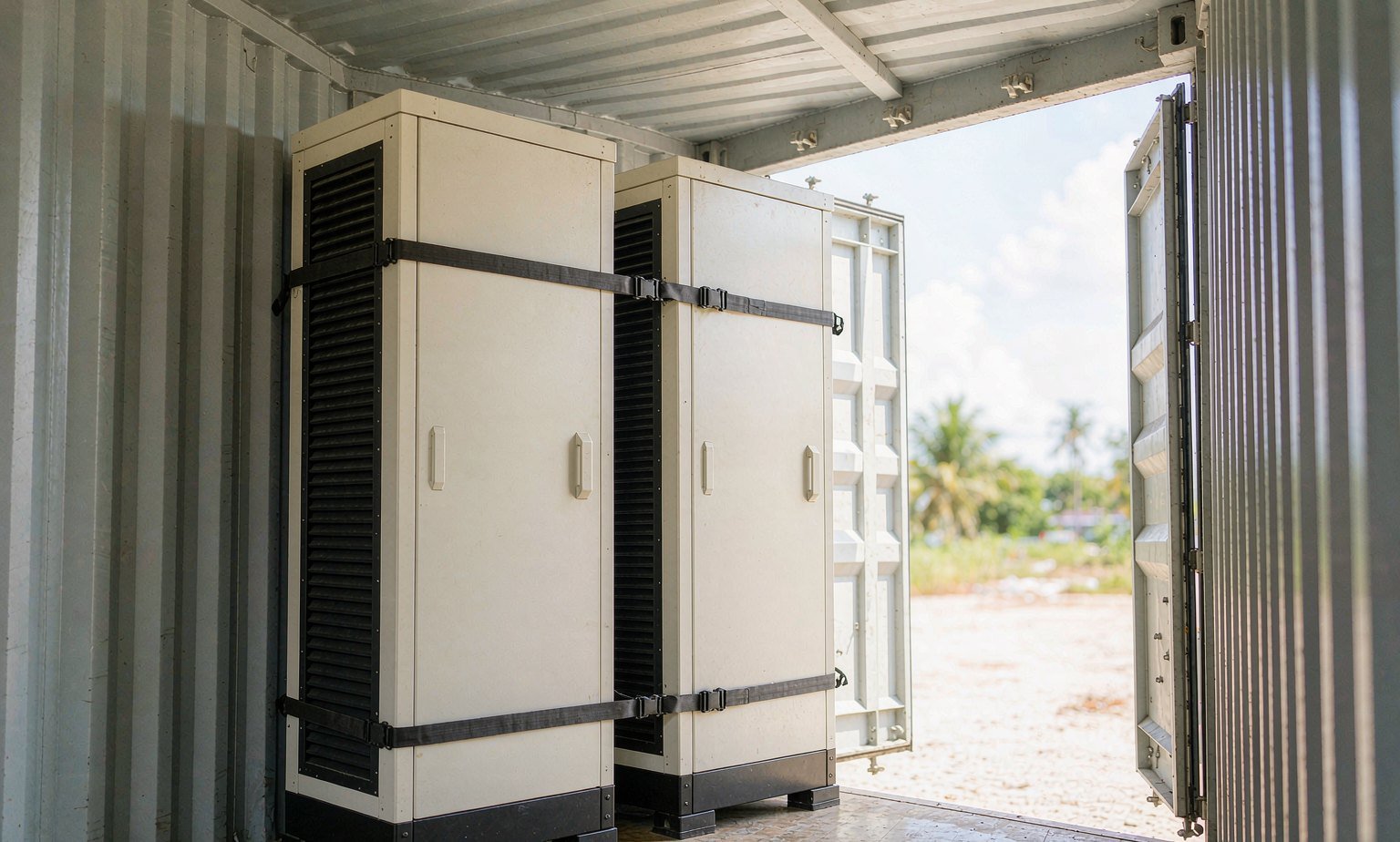
The technical file an appointed firm will ask for
Regulated products are tested against Nigerian Industrial Standards where they exist, and against accepted international equivalents where they do not. The soncap battery storage nigeria technical file is stable across projects, and assembling it once saves weeks on every shipment after the first.
Four documents carry the soncap battery storage nigeria argument. UN38.3 covers transport of the cells. IEC 62619 covers safety of industrial lithium cells and batteries. IEC 62040-1 covers the uninterruptible power system that the cabinet presents to the site. A CE declaration and the material safety data sheet complete the set. Our 100kW / 215kWh battery energy storage system ships with all four against the serial number of the unit.
The file also has to survive a physical check. Nameplate rating, model designation and cell chemistry must match the product certificate, and the label must be in English. Anything printed only in Chinese creates a question at the inspection that no certificate answers, which is how a soncap battery storage nigeria consignment becomes a query file.
Warranty wording belongs in the soncap battery storage nigeria file too, because assessors ask what the unit is rated to do. Our cabinets carry 10 years or 6,000 cycles at 80% depth of discharge, whichever comes first. The modules carry 12 years of product warranty and 25 years of linear output. A certificate claiming a longer life than the warranty supports is a document that invites a second look.

The same question in your other markets
Importers buying for more than one country usually assume the Nigerian file can be reused. The technical evidence travels; the soncap battery storage nigeria certificate does not. A soncap battery storage nigeria certificate means nothing at another border, because each destination appoints its own conformity bodies and issues its own release document.
In the Philippines the constraint is usually the import permit and the standards bureau route rather than a pre-shipment certificate, and the practical delay sits with the permit. In Ghana the national standards authority runs its own conformity route and the release document is issued against it. In Kenya the pre-export verification of conformity is the gate, and like SONCAP it is performed in the country of supply.
Across the Caribbean and Central America the pattern is fragmented by country, and none of it resembles the soncap battery storage nigeria route. Some islands accept an IEC test report with a declaration, others require a national mark before the container is released. In the Gulf the soncap battery storage nigeria model does not apply, and the requirement is usually a certificate of conformity from a recognised body, and the dossier is closer to the European one than to the Nigerian one.
The reusable asset is the technical file. UN38.3, IEC 62619, IEC 62040-1 and the datasheet are accepted almost everywhere as evidence; the certificate built on top of them is national. Buy the evidence once and budget one certificate per market, in the same way a soncap battery storage nigeria shipment budgets one for Lagos.
For country-level detail on sizing and landed cost rather than documents, start from our Nigeria market page and the load-capability piece on what a 100kW/215kWh system can actually power.
The pre-shipment checklist
The soncap battery storage nigeria sequence has twelve steps, in the order they have to happen. Anything out of order costs days rather than money, and days at the port are the expensive ones. A soncap battery storage nigeria shipment that skips step five usually repeats steps six to eight.
- Confirm the product is regulated. Battery storage is not on the exemption list, which covers food, medicines, raw-material chemicals, military goods and used products other than vehicles.
- Choose the product certificate grade against shipment frequency, not against the first order.
- Contract an appointed inspection firm and submit the technical file with the model designation you will use on the invoice.
- Fix the HS code, and use an Advance Ruling if the unit could fall under two headings.
- Hand the product certificate to the importer before the proforma invoice is finalised.
- Importer opens the Form M through an authorised dealer, with the certificate number on it.
- Importer activates the certificate so that it is visible against the importer record.
- Apply for the shipment certificate once the goods are packed and before they are loaded.
- Book the pre-shipment inspection with the unit accessible, not behind two rows of pallets.
- Check every document against every other: model, quantity, value, HS code, consignee.
- The bank uploads the final documents so that the PAAR can be generated.
- The agent files for assessment, duty is paid, and the container is released.
Step ten is the one worth paying a second person to do. Every failure in the previous section is a step-ten failure, and step ten costs an hour. That hour is the cheapest line in the whole soncap battery storage nigeria budget.