
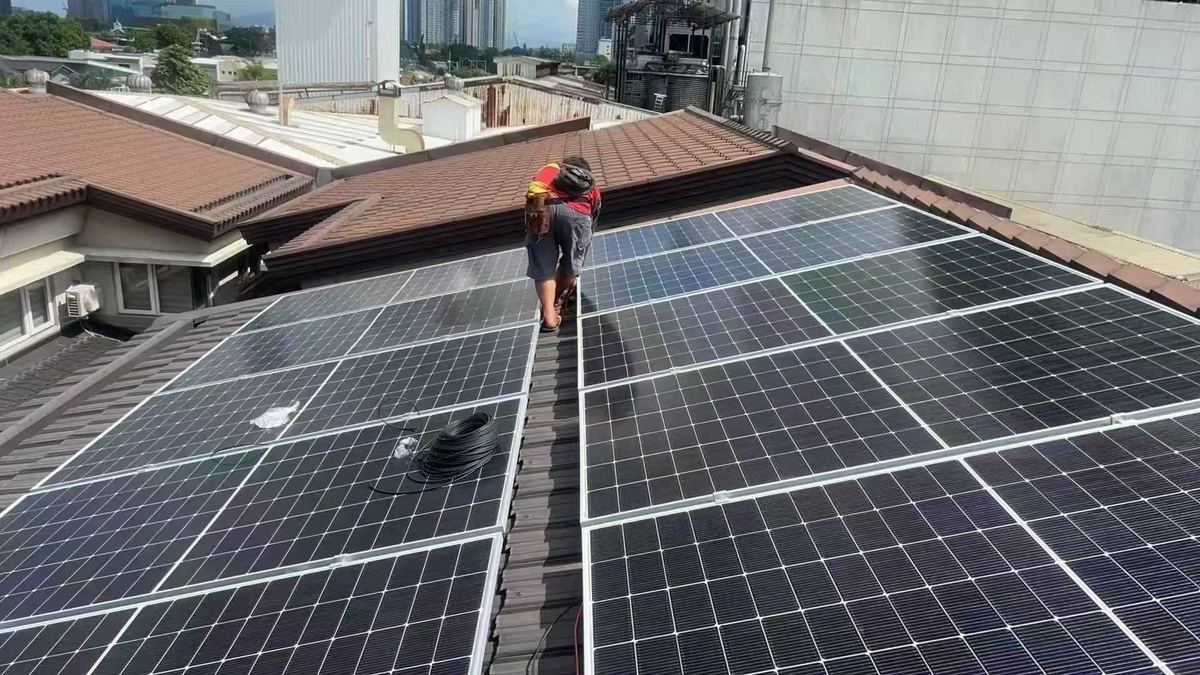
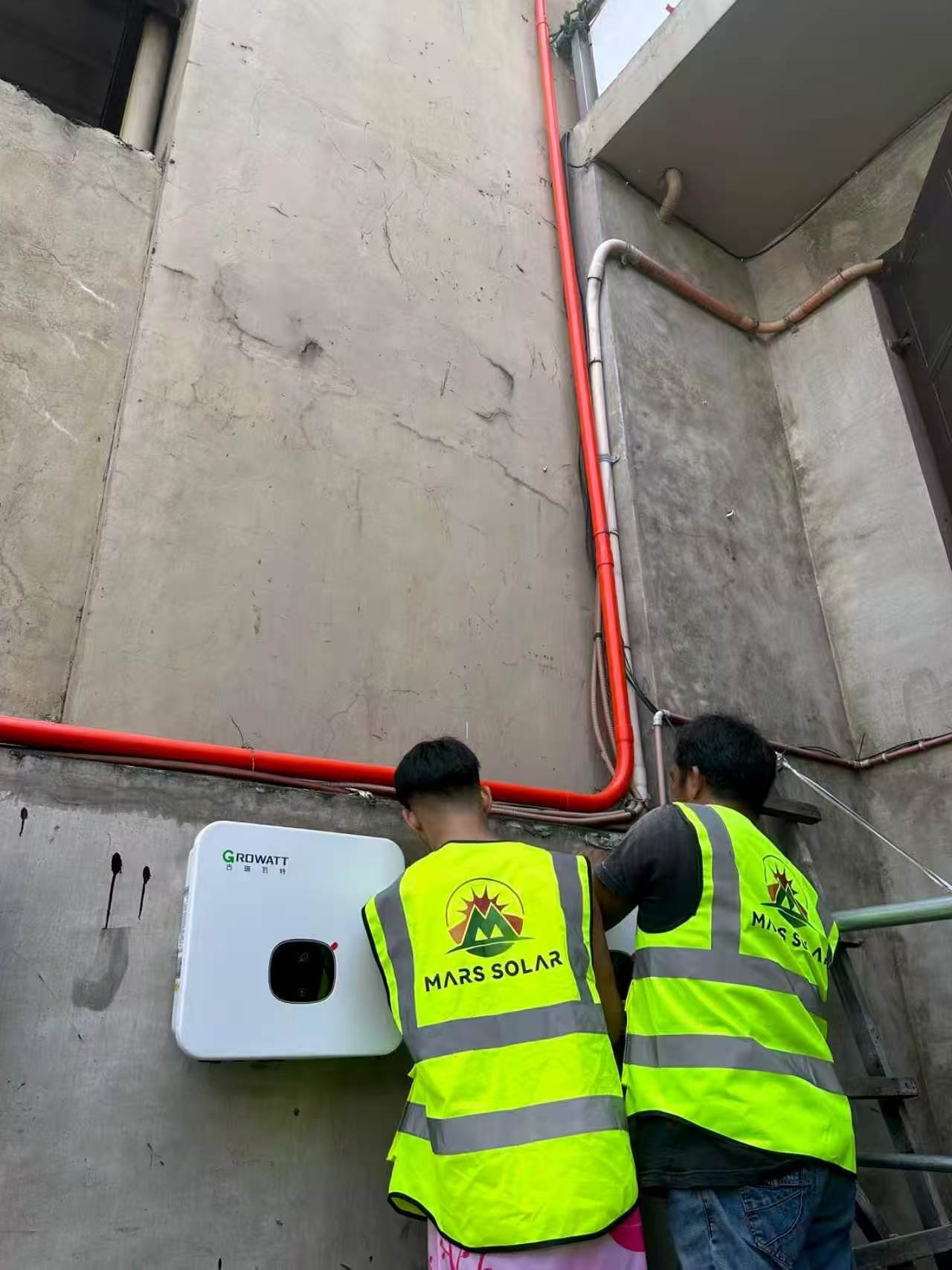
A commercial solar Philippines project is not a complicated purchase, but it does have three non-negotiable inputs: what you pay per kilowatt-hour today, how much of your consumption happens in daylight, and whether the kit can be cleared through Philippine customs and mounted to survive typhoon season. Get those three right and the payback lands inside three to five years for most daytime-load businesses. Get any one wrong and the spreadsheet stops working.
What Commercial Solar Philippines Projects Save: Your Starting Anchor
Everything downstream starts from one number. The Philippine commercial tariff anchor we work from is $0.156 per kWh (GlobalPetrolPrices, December 2025). Your own utility bill will differ by distribution utility and by rate class, so always re-run this page using your actual blended rate — but $0.156/kWh is the reference point used throughout this page.
| Input | Planning value | Basis |
|---|---|---|
| Commercial electricity tariff | $0.156 / kWh | GlobalPetrolPrices, December 2025 — replace with your blended rate from your own bill |
| Landed cost adder over CIF | +20% to +35% | Verified internal anchor: freight, duty, VAT, local installation and commissioning |
| Specific yield (planning range) | 1,400 to 1,600 kWh / kWp / year | Tropical planning range for Luzon and Visayas — must be confirmed with a site-specific simulation |
| Daytime self-consumption | 80% to 90% | Typical for hotels, malls and single-shift factories running 8am to 6pm |
| Module price (FOB China) | $0.28 to $0.48 / W | Verified internal anchor |
| Storage share of system cost | 35% to 50% | Verified internal anchor |
Notice what is not on that list: any government subsidy. Philippine C&I solar runs on plain self-consumption economics. There is no feed-in premium worth modelling, so assume every kilowatt-hour you export earns little or nothing and every kilowatt-hour you consume yourself saves the full $0.156.
Certification and Grid Rules Before You Ship Anything
Imports of photovoltaic modules and inverters into the Philippines fall under the product certification scheme administered by the Bureau of Product Standards (BPS) under the Department of Trade and Industry. The practical point for a buyer: the certification window is not open-ended. The deadline currently referenced for full BPS coverage of solar photovoltaic products is July 2027, and consignments without the right import commodity clearance documents get held at the port.
Requirements change, and the acceptable proof differs between a container of modules and a container of inverters, so confirm the current requirement with your broker before you book space. What we supply as standard, and what you should demand from any supplier, is:
- IEC 61215 / IEC 61730 module certificates from an accredited lab, plus IEC 62109 for inverters and IEC 62619 for lithium cells.
- Salt-mist corrosion testing for coastal and island sites — the Philippine archipelago is a salt environment, and this is the single most skipped test.
- Structural wind calculations stamped for your site's design wind speed, referenced to the National Structural Code of the Philippines, for any rooftop array.
- Grid-connection paperwork for your distribution utility (net-metering or zero-export depending on the utility and your contract demand).
If you want the deep dive on how each certificate is obtained and what it does not prove, read our solar system certifications explained guide.
A Worked Payback: 100 kWp Plus 215 kWh
Here is the arithmetic we use in commercial solar Philippines proposals, with every assumption written out so you can audit it.
Step 1 — System cost. A 100 kWp array paired with a 215 kWh lithium battery cabinet ships from China at a verified CIF range of $88,000 to $115,000. Add the landed cost adder of 20% to 35%:
- Low case: $88,000 x 1.20 = $105,600 landed
- High case: $115,000 x 1.35 = $155,250 landed
Step 2 — Storage versus generation. Storage is 35% to 50% of total system cost. Working backwards gives the PV-generation portion alone:
- Low case: $88,000 x (1 - 0.50) = $44,000 for array plus balance of system
- High case: $115,000 x (1 - 0.35) = $74,750 for array plus balance of system
- Landed: $52,800 to $100,900
Step 3 — Annual generation and savings. At the planning yield midpoint of 1,450 kWh/kWp/year, a 100 kWp array produces 145,000 kWh a year. At 85% daytime self-consumption that is 123,250 kWh displaced, and at $0.156/kWh:
- 123,250 kWh x $0.156 = $19,227 saved per year (modules-priced separately: 100 kW = 100,000 W x $0.28 to $0.48/W = $28,000 to $48,000 of that system cost)
Step 4 — Payback.
| Configuration | Landed cost | Annual saving | Simple payback |
|---|---|---|---|
| Generation-led (array + BOS only) | $52,800 to $100,900 | $19,227 | 2.8 to 5.2 years |
| Full hybrid (100 kWp + 215 kWh) | $105,600 to $155,250 | $19,227 | 5.5 to 8.1 years |
This is the honest picture, and it is worth understanding rather than hiding: at $0.156/kWh the battery part of the system pays for itself in resilience, not in tariff arbitrage. Philippine businesses buy the storage because an unplanned outage in a hotel, a cold store or a BPO floor costs more than the kilowatt-hours would. If your outage cost is real, price it in and the full hybrid becomes the right answer. If your site has a reliable feeder, lead with the array and add storage later.
For a Philippine-specific price breakdown by system size, see our solar power system price Philippines 2026 guide. The hardware we most often ship for this duty is the 100 kVA / 100 kW / 215 kWh BESS.
Specifying for Philippine Conditions: Typhoon, Heat and Salt
Three things kill premature systems here, and none of them is the panel brand:
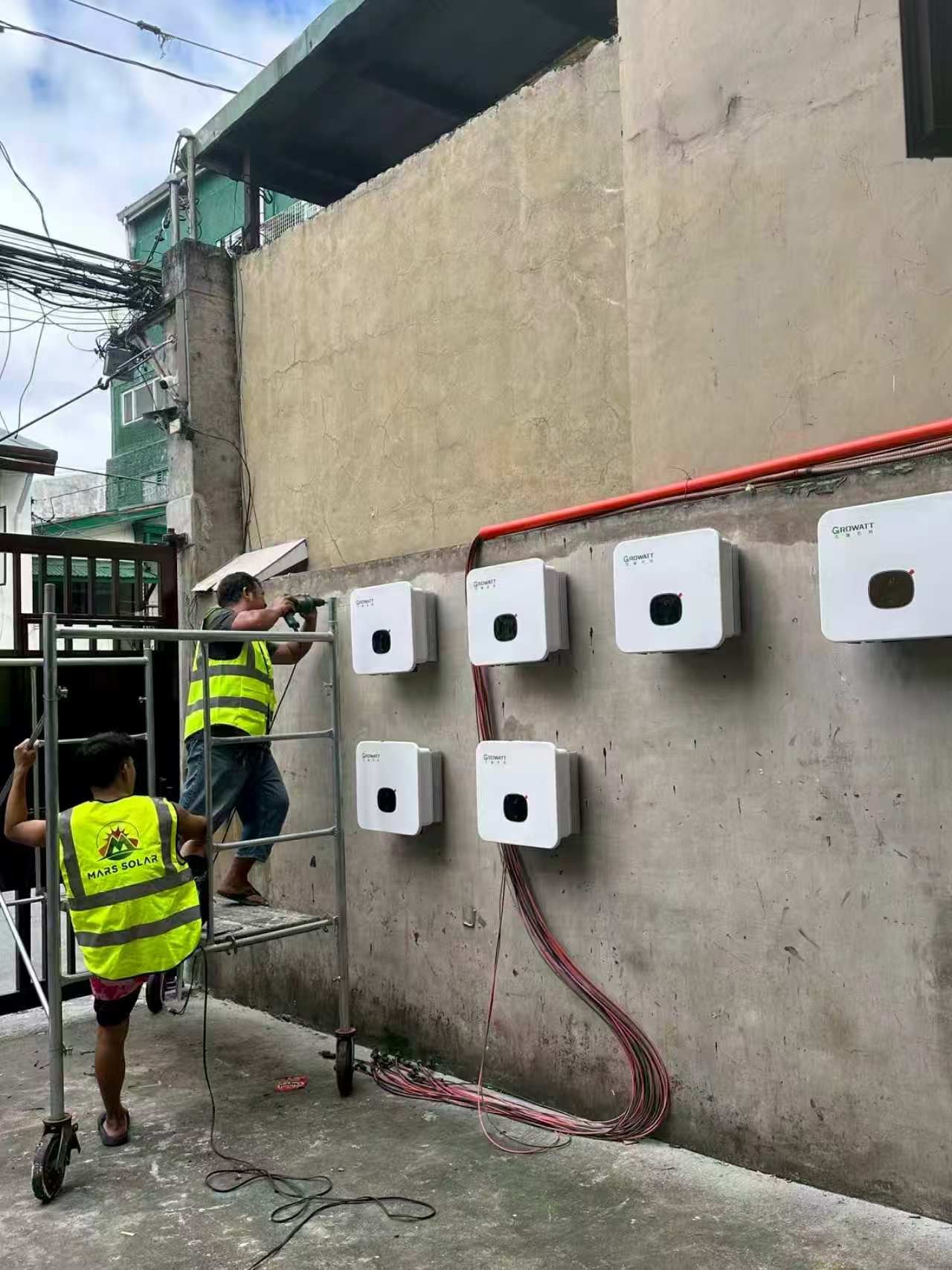
Wind uplift. A Philippine rooftop array is designed to a design wind speed from the National Structural Code, not to a rule of thumb. Ask your supplier for stamped calculations that name the code edition and your building's risk category. If your project is in the eastern seaboard or the Visayas, the attachment and ballast design is doing more work than the module warranty.
Heat. Ambient temperatures and low wind behind a tilted array push cell temperatures high, which costs output above the standard test condition rating. Read the temperature coefficient on the datasheet, not just the peak watt figure.
Salt and humidity. Specify salt-mist-tested frames and stainless fasteners of the right grade. We wrote about how the same damage mechanism behaves in Middle Eastern desert environments in our solar panels Middle East heat article, and the typhoon-specific structural detail is covered in our hurricane resistant solar Caribbean guide — both apply directly to the Philippines.
We have done exactly this work locally: see our Philippines 60 kW resort solar-plus-storage project, an island site where export was capped, the roof needed a wind-engineered design, and the storage was sized for guest-room continuity rather than for bill savings.
Sizing Commercial Solar Philippines Systems: Start From the Load, Not the Roof
The most common sizing mistake in commercial solar Philippines projects is working backwards from roof area. Roof area is a constraint check, not a design input. The design input is the load profile: which equipment runs when, and how many of those kilowatt-hours land inside the solar day.
Pull twelve months of utility bills, then a representative week of hourly interval data if your meter provides it. What you are solving for in a commercial solar Philippines load audit is the daytime kW draw and the hour-by-hour kWh split — the array is sized against daytime consumption, the battery against the loads you cannot afford to lose:
| Load type | When it runs | What it means for a commercial solar Philippines design |
|---|---|---|
| Single-shift factory machinery | 08:00 to 18:00 | Best match to the solar window — the 80% to 90% self-consumption band assumes this profile |
| Guest-room and common-area AC | Day plus evening peak | The evening portion cannot be served by the array; it goes to the grid or to storage |
| Cold storage and refrigeration | 24 hours | Highest outage cost on the property — continuity, not savings, decides the battery here |
| POS, front desk, office IT | Business hours | Small kW draw but revenue-critical — cheap to back up, expensive to lose |
| Pool pumps and water treatment | Daytime, deferrable | Shifting these loads into the solar window raises self-consumption at zero hardware cost |
Size the array against daytime consumption first, then check roof area and structure as constraints. Our step-by-step sizing guide walks the full arithmetic — this load table is the input every commercial solar Philippines calculation starts from.
Three Commercial Solar Philippines Configurations, and Which One Fits
Every commercial solar Philippines quotation lands on one of three archetypes, and the arithmetic traces straight back to the payback table earlier on this page:
| Configuration | What ships | Landed cost, 100 kWp basis | Simple payback | Buy it when |
|---|---|---|---|---|
| Generation-led | Array + inverters + BOS, no battery | $52,800 to $100,900 | 2.8 to 5.2 years | Your feeder is reliable and your problem is the bill |
| Critical-load hybrid | Array + battery sized to named loads only (AC, cold storage, POS) | Between the two — set by the storage share, 35% to 50% of system cost | Between the two | Outages hurt, but only in specific rooms and equipment |
| Full hybrid | 100 kWp + 215 kWh battery cabinet | $105,600 to $155,250 | 5.5 to 8.1 years | An unplanned outage anywhere on the property costs more than the storage premium |
If you are comparing commercial solar Philippines quotations, ask which of the three you are looking at — it is the fastest way to tell whether two numbers are comparable. The critical-load hybrid is the pattern behind our Palawan resort project: 60 kW of PV with 120 kWh of storage deliberately sized to carry air conditioning, cold storage and POS, not the whole property. Sizing storage to named loads is how a commercial solar Philippines buyer stays near the bottom of the 35% to 50% storage band while still buying the continuity that matters.
Backup Coverage: The Arithmetic Behind Commercial Solar Philippines Storage
Storage in a commercial solar Philippines project is bought in hours of continuity, so the arithmetic should be done in hours:
Runtime = usable battery kWh ÷ backed-up load kW
Run the commercial solar Philippines backup calculation twice — once at nameplate, once at the usable capacity on your datasheet. Applied to the 215 kWh cabinet from the payback example, at nameplate:
| Backed-up load | Runtime on 215 kWh nameplate | Worked as |
|---|---|---|
| 10 kW (front desk, IT, lighting circuit) | ~21.5 hours | 215 ÷ 10 |
| 20 kW (AC zone plus refrigeration) | ~10.7 hours | 215 ÷ 20 |
| 40 kW (full guest wing) | ~5.4 hours | 215 ÷ 40 |
| 50 kW (half-property island mode) | ~4.3 hours | 215 ÷ 50 |
Two derates matter before these numbers go into your spreadsheet. Usable capacity is lower than nameplate — read the usable kWh on the datasheet, not the marketing figure. And the inverter's continuous rating caps what the island panel can draw at once, which is why the load table above matters: a 60 kW chill room on a 50 kW inverter island is a design error no battery capacity fixes. In Palawan, a 120 kWh bank sized this way carried AC, cold storage and POS through outage windows — the same arithmetic applied to your commercial solar Philippines load list is what we run in every proposal.
Excess Generation: Net Metering and Zero-Export for Commercial Solar Philippines Sites
What happens to the kilowatt-hours your array produces but you cannot use? In the Philippines the answer depends on your distribution utility and your contract demand: the connection is set up either under net metering, where exported energy offsets part of your bill, or under zero-export, where the inverter never pushes power back to the grid.
The planning assumption on this page is deliberately conservative: value only the kWh you self-consume at $0.156, treat exports as earning little or nothing, and design the load to raise self-consumption instead. That 80% to 90% band is where the money is in a commercial solar Philippines model — the export fraction is where it leaks.
If your site is in the Meralco service area, the net-metering application process is published on their website: Meralco solar net-metering application process. Other utilities run their own distributed-generation desks — ask before the system is designed, because the export arrangement changes inverter configuration, metering and sometimes protection relaying, all cheaper to get right at design stage than to retrofit on a live commercial solar Philippines installation.
Island sites sit at the other end of the commercial solar Philippines spectrum: our Palawan project ran under an export cap, the control system clipping excess generation instead of exporting it. Zero-export is a setting on the hybrid inverter, not a hardware add-on, but it must be specified and tested at commissioning. Getting the export question right is part of commercial solar Philippines grid compliance, not an afterthought.
Installation Cost Checklist: Where the Commercial Solar Philippines Landed Adder Goes
The 20% to 35% landed adder over CIF is not a rounding allowance — it is a specific list of line items. This is the checklist we walk through when a commercial solar Philippines buyer asks what the landed number contains:
| Cost block | What it covers | Notes |
|---|---|---|
| CIF hardware | Modules, inverters, battery cabinet, mounting structure, cabling, protection | $88,000 to $115,000 for the 100 kWp + 215 kWh reference system; modules alone $28,000 to $48,000 at $0.28 to $0.48/W FOB |
| Freight and port charges | Container shipping, terminal handling, documentation | Sea transit from China is days plus port clearance — why Philippine adders often sit near the bottom of the band |
| Duty and VAT | Import duties and Philippine VAT on the consignment | Confirm current rates with your broker; BPS paperwork interacts with clearance |
| Local installation | Mounting to the wind design, DC/AC wiring, switchgear tie-in | Stamped calculations to the National Structural Code come in the engineering pack |
| Commissioning | Testing, protection settings, export-control configuration, performance verification | Export control is configured and tested here, not left as a site setting |
What is not in the adder: the grid-connection application to your distribution utility, switchroom civil works, and internal electrical upgrades if your main panel needs work. Those are owner-side items in most commercial solar Philippines contracts and belong in your own budget line, not hidden inside a commercial solar Philippines supplier quotation.
Case Evidence: A 60 kW Commercial Solar Philippines Project on Palawan
Every model on this page has a real-world counterpart: our Philippines 60 kW resort solar-plus-storage project on Palawan. The as-built numbers behind the commercial solar Philippines arithmetic above:
| Metric | As built |
|---|---|
| System | 60 kW array + 120 kWh battery storage |
| Monthly electricity bill | ₱145,000 down to ₱25,000 — an 83% reduction |
| Simple payback | 15 months |
| Installation window | 5 days on site |
| Storm record | Rode out Typhoon Egay with zero damage on a wind-engineered roof attachment |
| Backup scope | Air conditioning, cold storage, POS systems |
| Grid arrangement | Export capped — zero-export to the feeder |
Two things in this commercial solar Philippines case file are worth noticing. The 15-month payback is far faster than the 2.8-to-5.2-year grid-tariff model above, because an island site's effective cost of power runs well above the $0.156 grid anchor once diesel blending and outage losses are counted — the same hardware pays back faster. And the backup scope was deliberately limited to AC, cold storage and POS: a named-load design, exactly the critical-load hybrid from the configuration table, doing what it is built to do in a commercial solar Philippines setting.
How a Commercial Solar Philippines Project Is Delivered and Supported
From first enquiry to handover, a commercial solar Philippines project runs in six steps, and the sequence matters:
- Design and quotation — 24 hours. Send twelve months of electric bills and a roof photo; the first design and quotation comes back within 24 hours, sized to daytime load and engineered to your design wind speed.
- Engineering pack. Stamped wind calculations referenced to the National Structural Code, single-line diagrams, and the certification file: IEC 61215 / 61730 for modules, IEC 62109 for inverters, IEC 62619 for lithium cells, salt-mist reports for coastal sites.
- Production and paperwork. Lead time is usually dominated by production and certification documents rather than sailing time; confirm BPS import clearance requirements with your broker at this stage, not at the port.
- Shipping. Sea freight from China is days plus port clearance for Philippine consignments.
- Installation. The Palawan 60 kW system went from arrival to handover in five days on site; projects above roughly 200 kW are staffed with two to four resident commissioning engineers through the installation window.
- Commissioning and handover. Protection settings, export-control configuration and performance verification against design, then documented handover.
After handover, spares and warranty support run through the same project channel — agree the response commitments in the commercial terms during contracting rather than assuming them. These six steps are how every commercial solar Philippines shipment we make is run, and the quickest way to see the deliverables is the free first step above: bills and a roof photo in, a costed commercial solar Philippines design out.