
A hurricane resistant solar Caribbean installation is not defined by a tougher panel — it is defined by a design wind speed taken from the building code, attachments engineered to carry uplift into the roof structure, and documentation complete enough for an insurer to underwrite. Get the three right — ASCE 7-based wind loads, edge-zone-aware attachment design, and modules certified to 5400 Pa front / 2400 Pa rear with the right clamp configuration — and a commercial rooftop array can ride out a Category 4 storm. Get them wrong, and even a tropical storm can peel an array off a roof and open the membrane below it.
Hurricane Resistant Solar Caribbean Projects Start With the Design Wind Speed
Every structural decision downstream depends on one number: the basic design wind speed V — a 3-second gust at 10 metres, defined by ASCE 7 and adopted through the IBC or your island's national building code. In hurricane-prone regions this is not a gentle figure: along the US Gulf and Atlantic coasts, and by extension the hurricane belt of the Bahamas, the Greater Antilles and the Lesser Antilles, Risk Category II values typically fall between roughly 140 and 180 mph, with the highest values reserved for essential facilities. Jurisdictions differ — some islands enforce updated IBC-based codes, others still work from older national documents — so never assume: have a licensed local engineer state the applicable V, Risk Category and code edition in writing. Higher-occupancy buildings (hospitals, shelters, schools) may require a higher Risk Category, which raises the wind speed and therefore every load in the calculation. After Category 5 Hurricane Melissa struck Jamaica in October 2025, regional scrutiny of this number intensified — keep design wind speed on the first page of any proposal you receive.
How Wind Load Actually Works on a Rooftop Array
Wind pressure on a panel is not a single force; it is velocity pressure modified by exposure, height, gust effect and — critically — the panel's position on the roof. The ASCE 7 velocity pressure follows the form qz = 0.00256 · Kz · Kzt · Kd · V² (psf, with V in mph), so at 160 mph the base dynamic pressure alone is on the order of 65 psf (about 3.1 kPa) before any coefficients apply. Then geometry takes over: in the corner and edge zones of a roof, suction coefficients are typically 2–3 times higher than in the interior field, because wind separates at those edges. That is why arrays fail at corners first, why code-compliant designs pull modules back from roof edges with perimeter setbacks, and why a parapet can meaningfully reduce design loads — and it is the single most misunderstood aspect of hurricane resistant solar Caribbean buyers raise with our engineers. Any honest structural package will show you a zone map of the roof with different uplift pressures per zone — if a supplier quotes one uniform load for the whole roof, the calculation is not done.
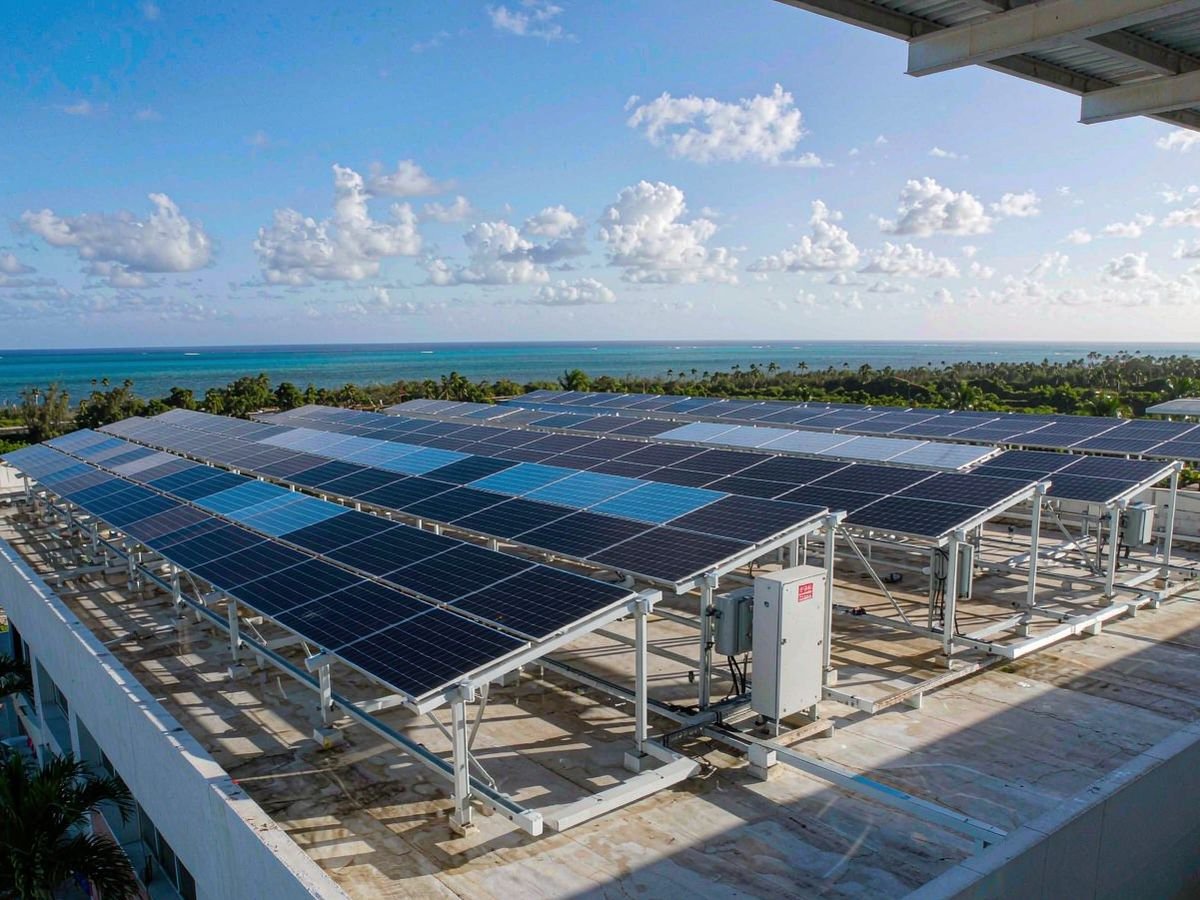
Roof Attachment: Penetrating vs Ballasted vs Adhesive
How the array connects to the building decides both its uplift capacity and its risk to the membrane. There is no universally "best" method — the answer depends on roof type, building height, wind zone and how your insurer reads the drawings.
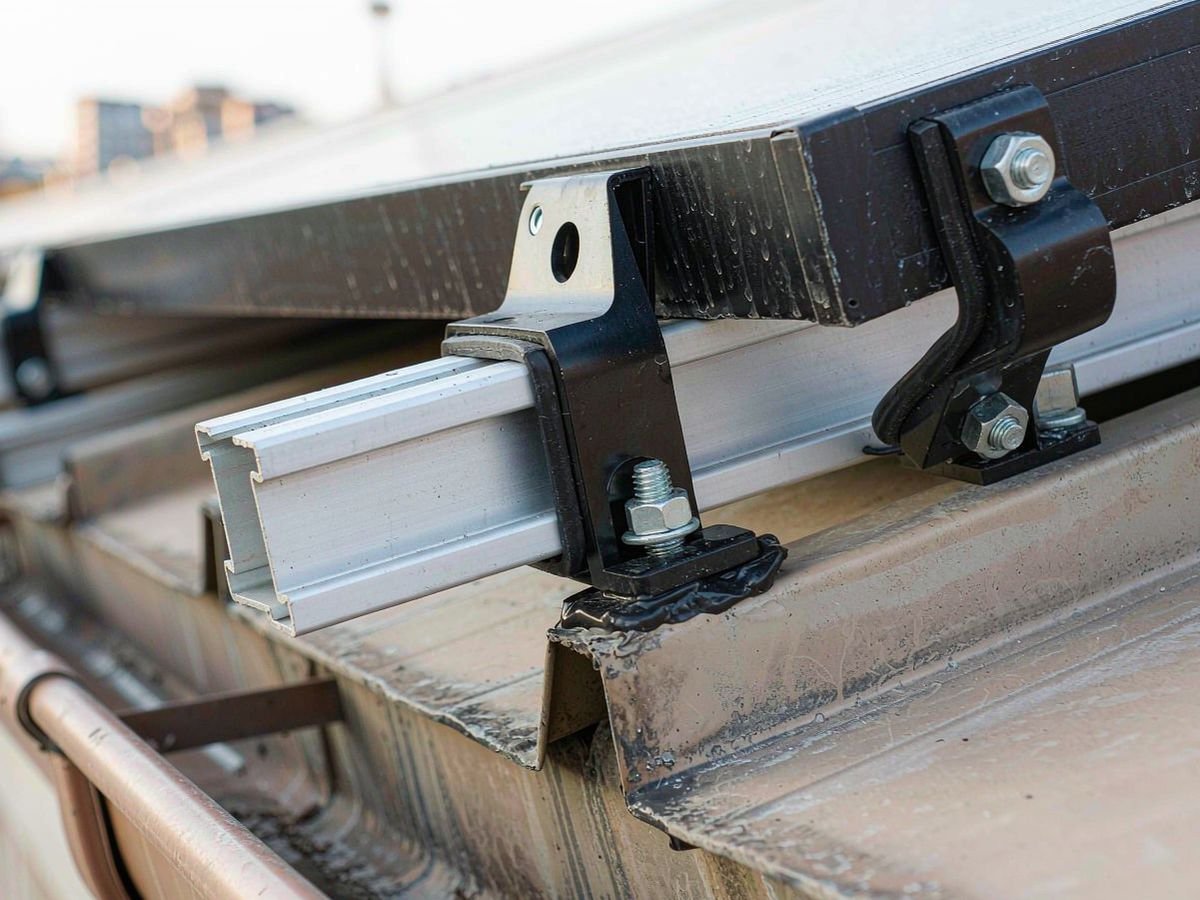
| Attachment method | Best suited for | Uplift capacity | Waterproofing risk | Insurer / permit acceptance |
|---|---|---|---|---|
| Penetrating (through-bolted to purlins or structural deck, flashed seals) | High wind zones, tall buildings, metal and concrete roofs | Highest — load path into structure | Managed with flashed, sealed penetrations; must be detailed correctly | Strongest — easiest to document and defend |
| Ballasted (weight-held, typically low-tilt on flat roofs) | Low-rise, sheltered, low-slope membranes that can carry extra dead load | Limited — resistance comes from mass | No penetrations, but heavy; roof structure must be verified | Weakens in high wind zones — often restricted or rejected |
| Adhesive / hybrid (bonded rails plus selective anchors) | Membrane roofs where penetrations are undesirable but wind is real | Moderate — depends on bond area and cure quality | Low if installed to spec; bond depends on membrane condition | Accepted case by case; demand pull-test data |
For hurricane resistant solar Caribbean installations, penetrating attachment into primary structure is usually the only option a structural engineer will sign off without heavy caveats — and it is the configuration Mars Solar used on our 250 kW supermarket rooftop in Curaçao.
What 5400 Pa / 2400 Pa Actually Tells You About a Module
Under IEC 61215, a module's static mechanical load test pushes 5400 Pa on the front face and 2400 Pa on the rear — roughly a 110 psf front load, which is why manufacturers describe their glass-laminate stacks as hurricane-grade. But the rating is only valid for the mounting method stated in the test report: four-clamp mounting on the long edges, bolted at the frame holes, or rail bonding all produce different results. A module clamped too far from the frame line, or on too few points, may fail well below its datasheet number. When you review a report, check three things: the test was done at the claimed pressures, the clamp/bolt configuration matches your racking design, and the frame deflection limits were met. The same logic applies to rails and clamps — ask the racking supplier for the allowable downloads and uplifts per span, not just an aluminium extrusion drawing. If you need a refresher on certificates, our solar certifications guide covers the full document set.
Certification and Insurance: Miami-Dade NOA as the Regional Benchmark
The strictest wind benchmark in the hurricane belt is Florida's High-Velocity Hurricane Zone (Miami-Dade and Broward counties), where products must pass TAS 201 (impact), TAS 202 (structural) and TAS 203 (loading) testing and hold a Notice of Acceptance (NOA). Even where your island does not enforce Miami-Dade rules, an NOA or equivalent ICC-ES evaluation report is the fastest way to satisfy a sceptical insurer — third-party proof under the region's worst wind environment. Underwriters evaluating a Caribbean commercial array typically want: stamped structural calculations for the actual site (not a generic brochure number), attachment detail drawings, module and racking certifications, installer qualifications, and commissioning photos of the fastened connections. Policies in the region commonly carry separate hurricane deductibles, and after a loss the claim often turns on one question — can you prove the system was installed as engineered? Systems with photo-documented attachments settle; systems without them fight.
Coastal Salt Fog: IEC 61701 and Corrosion-Smart Materials
Wind is only half the coastal problem; salt is the other. IEC 61701 rates a module's salt-mist corrosion resistance in severity levels, and for sites within a few hundred metres of the shoreline you should specify the higher severity levels the standard defines. Materials matter just as much: mill aluminium rails corrode fast in salt fog, so specify anodized aluminium structure, stainless steel (A2/A4, ideally A4/316) fasteners, and isolation where dissimilar metals meet to avoid galvanic corrosion — stainless bolts biting into bare aluminium without the right coating will seize and pit within a few seasons. Hot-dip galvanized steel is acceptable for larger ground-mount or carport structures, but on rooftops aluminium wins on weight and corrosion behaviour. Corrosion is not cosmetic: a rusted clamp is a clamp that lets go in a storm.
A Hurricane-Season Checklist for Commercial Rooftop Arrays
Caribbean hurricane season runs officially from June to November, so treat May as your engineering month. Every hurricane resistant solar Caribbean owner we work with runs essentially the same routine:
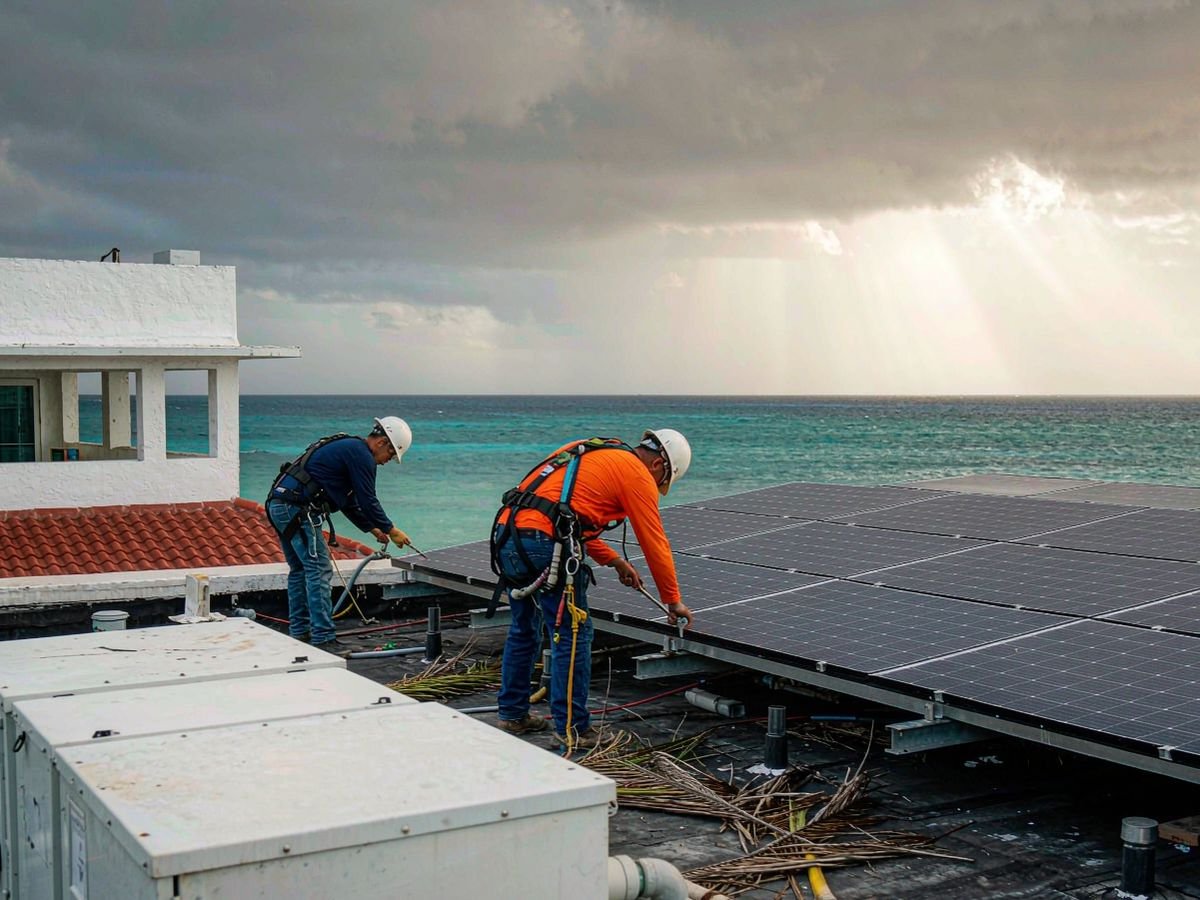
- Torque-check a sample of clamps and rails against the installation manual's values — thermal cycling loosens hardware over the years.
- Inspect every penetration, flashing and sealant bead; replace aged sealant before the water test arrives sideways.
- Clear roof drains and scuppers — ponding water plus wind-driven rain finds every weakness.
- Photograph the entire array, including module serials and attachment points, and store it off-site for insurance.
- Verify remote monitoring and alerts work, so you can see string-level failures the moment the storm passes.
- Confirm your policy's hurricane terms — deductible structure and whether rooftop solar is explicitly covered property.
- After any storm: inspect visually (or by drone) before touching anything, then run an insulation-resistance and string test before re-energising a wet or damaged array.
Documents to Demand Before You Sign a Supply Contract
The cheapest time to protect your array is before the purchase order. Require the supplier to deliver: a project-specific wind load calculation package referencing your site's design wind speed and code edition; attachment detail drawings for your exact roof type; the module's IEC 61215 report including the mechanical load section with clamp configuration; an IEC 61701 salt-mist certificate with severity level; racking certification or evaluation report (NOA / ICC-ES where available); the installation manual with torque tables; and the warranty text with the wind-damage exclusions highlighted — many warranties exclude damage above a stated wind speed or void coverage when installation deviated from the manual, so read that clause as carefully as the price. This discipline separates a bankable supplier from a container trader; our guide on how to choose a reliable solar power system supplier covers vetting in depth. If you are still fixing system size, start with how to size a commercial solar power system, then apply the wind engineering on top.
Hurricane resistant solar in the Caribbean is achievable with ordinary engineering rigour: the right design wind speed, honest zone-by-zone load calculations, attachments carried into structure, marine-grade materials and a complete paper trail. Mars Solar has built commercial and industrial systems for coastal sites across 135+ countries since 2008, including hurricane-belt projects like the Curaçao supermarket rooftop. Send us your roof drawings and utility bill — we will return a wind-engineered system design and quotation within 24 hours, free.