

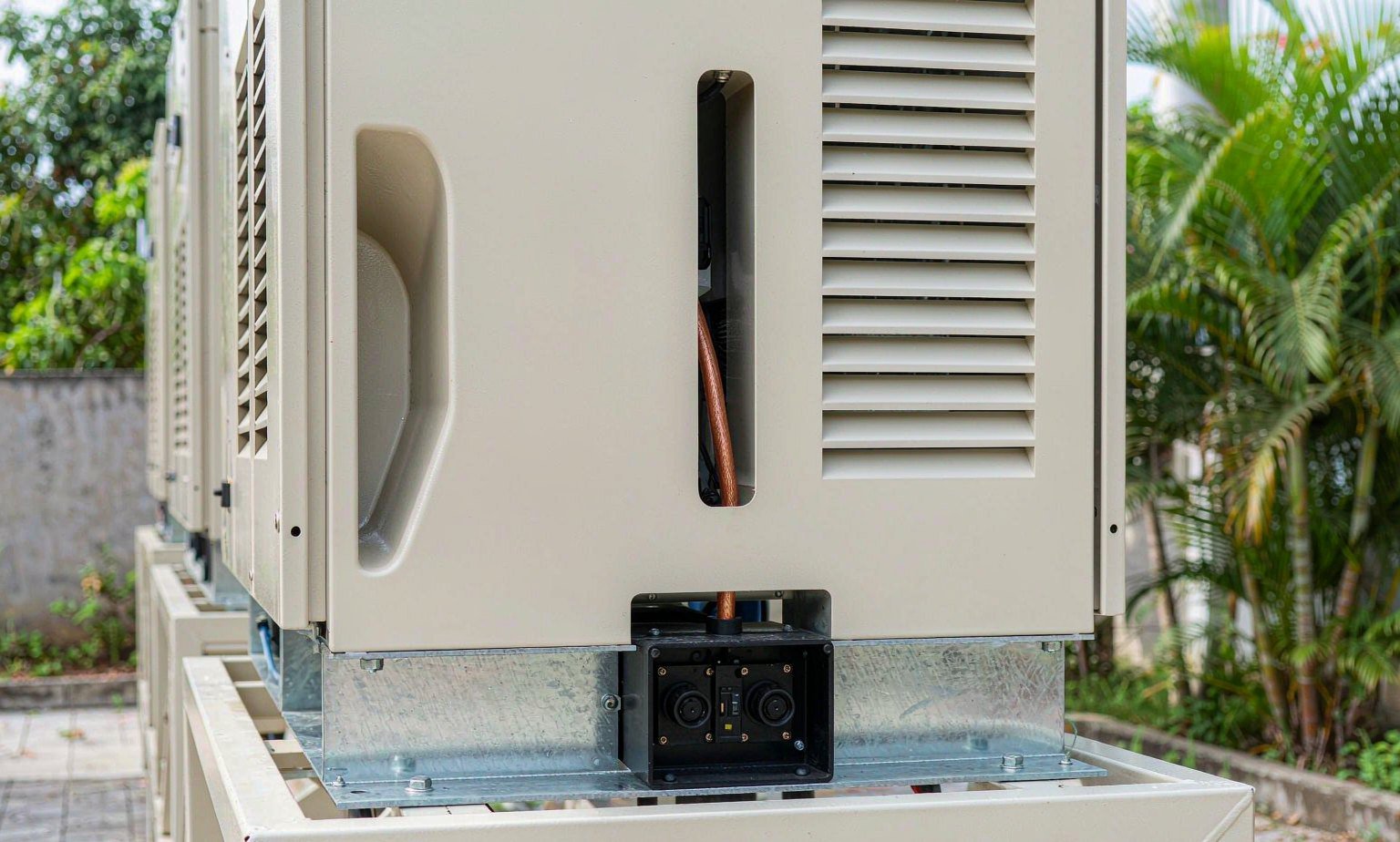
The photographs on this page are illustrative renders, not pictures of a specific client installation. The two charts are drawn from the arithmetic in the text.
Quick answer: battery storage sizing 100kw
Battery storage sizing 100kw starts from two separate numbers rather than one. The peak load sets the power conversion system: a 100 kW peak needs a 100 kW inverter, and that part is not negotiable. The energy you need behind it sets the battery, and that number depends on how long the site has to run, not on how big the peak is.
The working formula is short enough to check by hand. Nominal capacity in kWh = average load in kW × hours of autonomy ÷ (depth of discharge × converter efficiency). With 80% depth of discharge and a 95% efficient PCS, the divisor is 0.76, and every number in this article uses it.
Run it once on a factory. A 100 kW peak at a 0.65 load factor is 65 kW on average, and two hours of that is 130 kWh at the load. Divide by 0.76 and the battery has to be 171 kWh nominal, which is why the 215 kWh cabinet is the smallest standard unit that fits without cycling to its limit. For battery storage sizing 100kw, the same cabinet then delivers 1.6 hours at the full 100 kW and 2.5 hours at 65 kW.
Every number below assumes that split, and a battery storage sizing 100kw sheet that starts from a single nameplate is already wrong.
There is a second constraint that a pure energy calculation misses. A 100 kW load on a 100 kWh battery is a 1.00C discharge, double the continuous rate that most LFP cabinets are rated for, and the cycle life that the warranty quotes is written at a lower rate. In practice that sets a floor of about 2 kWh of nominal capacity per kW of peak load, so 100 kW rarely lands below 200 kWh whatever the outage length.

The two numbers behind every quote
Suppliers quote batteries in kWh and inverters in kW, and buyers compare them as if they were the same unit. They are not. In battery storage sizing 100kw, a 100 kW / 100 kWh system and a 100 kW / 215 kWh system have the same peak capability and completely different duty cycles, runtimes and prices. Only the second one is a two-hour machine.
The load factor is the bridge between them, and it is the number most quotes never state. It is the average load over a period divided by the peak in the same period. A hotel might run at 0.55, a cold store at 0.75, a single-shift factory at 0.65. Two buildings with an identical 100 kW peak can therefore need 145 kWh and 197 kWh of nameplate, and a sizing sheet that records only the peak cannot tell them apart.
That is the whole reason battery storage sizing 100kw is a survey exercise before it is a catalogue exercise. The peak is one line in a demand report. The load factor needs a week of interval data, or at minimum the utility's maximum demand reading plus a night-time walk around the site with a clamp meter.
For a commercial buyer the practical order is: measure the peak, measure the average, choose the outage you are designing for, then apply the formula. Three quotes built on the same 100 kW peak can differ by a factor of two, and the difference is almost never the equipment. It is the battery storage sizing 100kw inputs underneath them. Suppliers who quote a battery first and ask for the load profile second are selling a cabinet, not a design.
The sizing table, by building type
Five common 100 kW sites, run through the same formula. Same peak, five different battery storage sizing 100kw answers. The last column is the one that decides whether the cabinet is comfortable or marginal, and it is covered in the next section.
| Site with a 100 kW peak | Load factor | Outage to cover | Energy at the load | Nominal at 0.76 | Cabinet | Duty |
|---|---|---|---|---|---|---|
| Hotel or resort | 0.55 | 2.5 h | 137 kWh | 181 kWh | 215 kWh | 0.47C |
| Cold store | 0.75 | 4.0 h | 300 kWh | 395 kWh | 2 × 215 kWh | 0.23C |
| Factory, one shift | 0.65 | 2.0 h | 130 kWh | 171 kWh | 215 kWh | 0.47C |
| Clinic or hospital | 0.45 | 6.0 h | 270 kWh | 355 kWh | 2 × 215 kWh | 0.23C |
| Telecom or data rack | 0.85 | 1.0 h | 85 kWh | 112 kWh | 215 kWh | 0.47C |
The telecom row is the useful one. Energy alone says 112 kWh, and a 112 kWh cabinet would run the load for exactly the hour asked for. It would also discharge at 0.89C while doing it, close to the ceiling of a continuous LFP rating, with no headroom for a second hour or a hot afternoon. That is the battery storage sizing 100kw judgment the table cannot make for you. The 215 kWh cabinet is chosen for duty, not for energy, and that is a legitimate reason to double the battery.
Read the table backwards and it becomes a battery storage sizing 100kw quotation check. A supplier proposing 100 kWh for the factory row is undersizing by half. A supplier proposing 430 kWh for the hotel row is selling margin the site may not need, unless the outage design is longer than the 2.5 hours written here.
The arithmetic you can redo on one line
The formula deserves one worked example with every step visible, because battery storage sizing 100kw arguments usually come down to a disagreement about the divisor.
Every battery storage sizing 100kw calculation starts the same way. Step one, average load: 100 kW peak × 0.65 load factor = 65 kW. Step two, energy at the load: 65 kW × 2 hours = 130 kWh. Step three, nominal capacity: 130 ÷ (0.80 × 0.95) = 130 ÷ 0.76 = 171 kWh. Step four, nearest standard cabinet: 215 kWh, the next size up in the air-cooled cabinet family.
Run it backwards to check the battery storage sizing 100kw result. Usable DC energy is 215 × 0.80 = 172 kWh, and at 95% converter efficiency that is 163 kWh at the AC terminals. Divide by the 65 kW average and the answer is 2.5 hours. Divide by the full 100 kW and it is 1.6 hours.
That 1.6-hour figure is worth remembering, because nameplate-based charts often quote 1.7 hours for the same cabinet. The difference is the converter efficiency step: 172 ÷ 100 = 1.72 on the DC side, and 163 ÷ 100 = 1.63 at the load. Both are arithmetically right, and only one of them is what the site experiences.
If the two-hour duty has to hold in year eight rather than on commissioning day, add a second margin. Capacity fades over the 6,000 cycles the warranty covers, so a battery sized to exactly 171 kWh today is under 171 kWh later. Dividing the result by another 0.8 is a blunt instrument but it is honest: 171 ÷ 0.8 = 214 kWh, which lands on the same 215 kWh cabinet. That is a coincidence worth knowing about, not a rule that always holds.
Our 100kW / 215kWh battery energy storage system is the cabinet used in this example, and its nameplate, PCS rating and enclosure are documented on the product page. The runtime chart published alongside it uses the same 80% depth of discharge.
The C-rate ceiling nobody checks
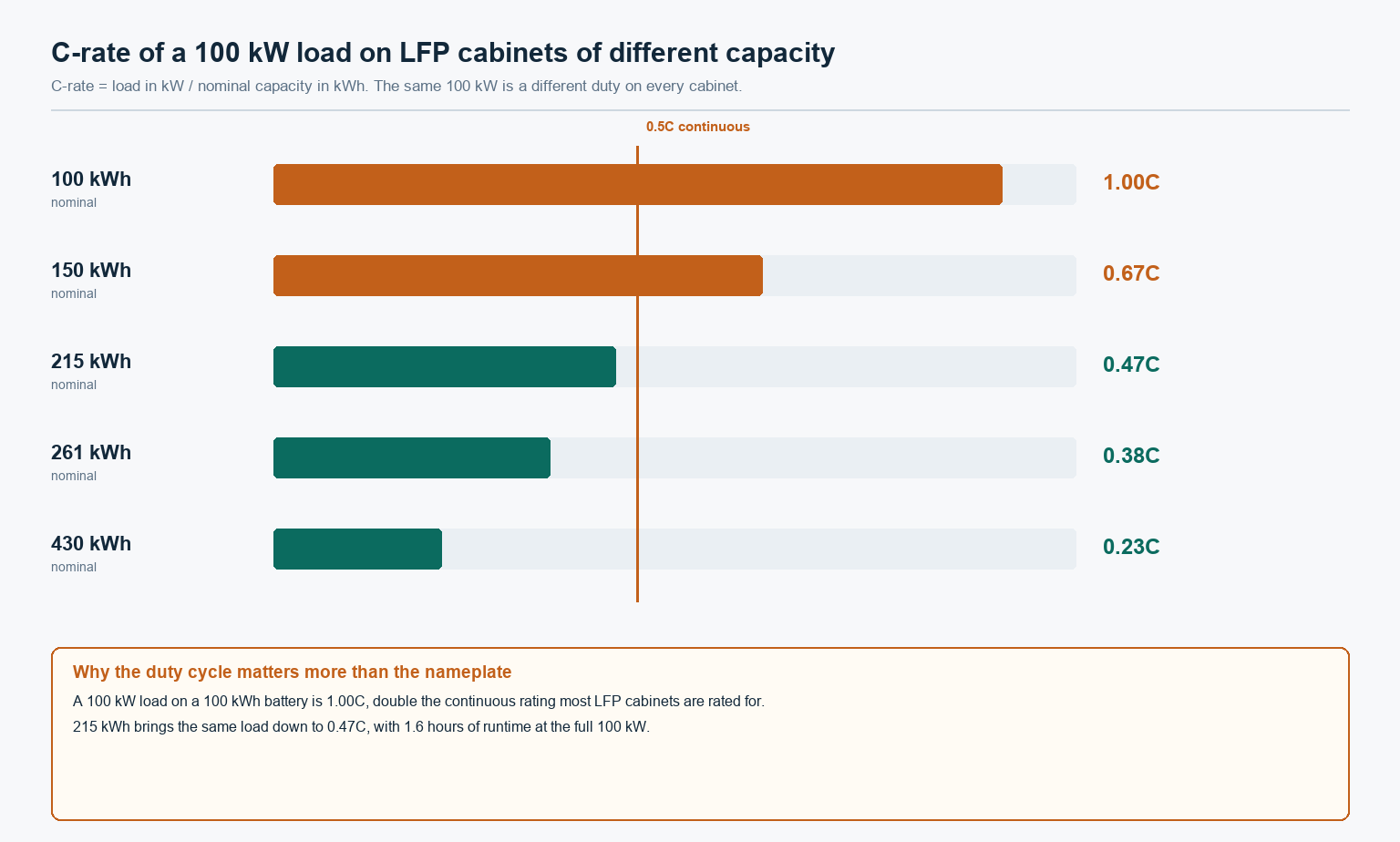
In battery storage sizing 100kw, C-rate is the load in kW divided by the nominal capacity in kWh. It is the number that decides how hard the cells are working, and it is absent from most quotations. A 100 kW load on 100 kWh is 1.00C; on 215 kWh it is 0.47C; on 430 kWh it is 0.23C. Same load, three different lifetimes.
LFP cabinets are generally rated for continuous discharge at around 0.5C, with short overload windows above that. A 1.00C duty sits outside the continuous rating from the first day, and the heat it produces is the same heat the thermal management has to remove. For battery storage sizing 100kw in a tropical plant room, that is the difference between an air-cooled cabinet running comfortably and the same cabinet running at its limit every evening. A sizing sheet that ignores C-rate is a runtime estimate, not a design.
Motor starting is the other half of the battery storage sizing 100kw power question, and it is not an energy question at all. A direct-on-line induction motor draws five to seven times its rated current for the few seconds it takes to accelerate, so a 30 kW compressor can present a 150–210 kW demand at start. The PCS either rides through that window or the motor is started on a variable speed drive or a soft starter and the surge never reaches the battery.
The practical battery storage sizing 100kw rule is to list every motor above 7.5 kW, note its starting method, and check the sum against the inverter's overload window. Where the surge cannot be avoided, the fix is usually a larger PCS rather than a larger battery, which is a cheaper correction than it sounds.
What the site survey has to record
Battery storage sizing 100kw is only as good as the load data behind it. Nine measurements cover almost every battery storage sizing 100kw case, and a site visit of two hours can collect all of them.
- Maximum demand from the utility bill, for twelve months, not one.
- Fifteen-minute interval data for at least seven days, ideally fourteen.
- Night-time base load, which is what an outage at 02:00 actually has to carry.
- Load factor, calculated rather than assumed.
- Every motor above 7.5 kW, with its starting method.
- Existing diesel generator rating, age and fuel consumption per hour.
- Phase balance at the main board, because a single-phase overload trips a three-phase supply.
- Ambient temperature in the proposed battery room, at 14:00 in the hot season.
- Footprint and door width, since a 215 kWh cabinet does not go through a 900 mm door.
The interval data is what turns a battery storage sizing 100kw estimate into a design. A week of 15-minute readings shows the morning ramp, the evening peak and the base load, and those three shapes are what battery storage sizing 100kw turns on: peak shaving, outage cover, or both. Without it, battery storage sizing 100kw becomes a conversation about nameplates.
Where interval data does not exist, battery storage sizing 100kw falls back on the utility's maximum demand reading plus a week of manual readings at shift change is enough to bound the answer. It is not elegant, and it is far better than sizing from a connected-load tally, which is always larger than the real demand and always produces an oversized quote.
Two buildings, the same 100 kW peak
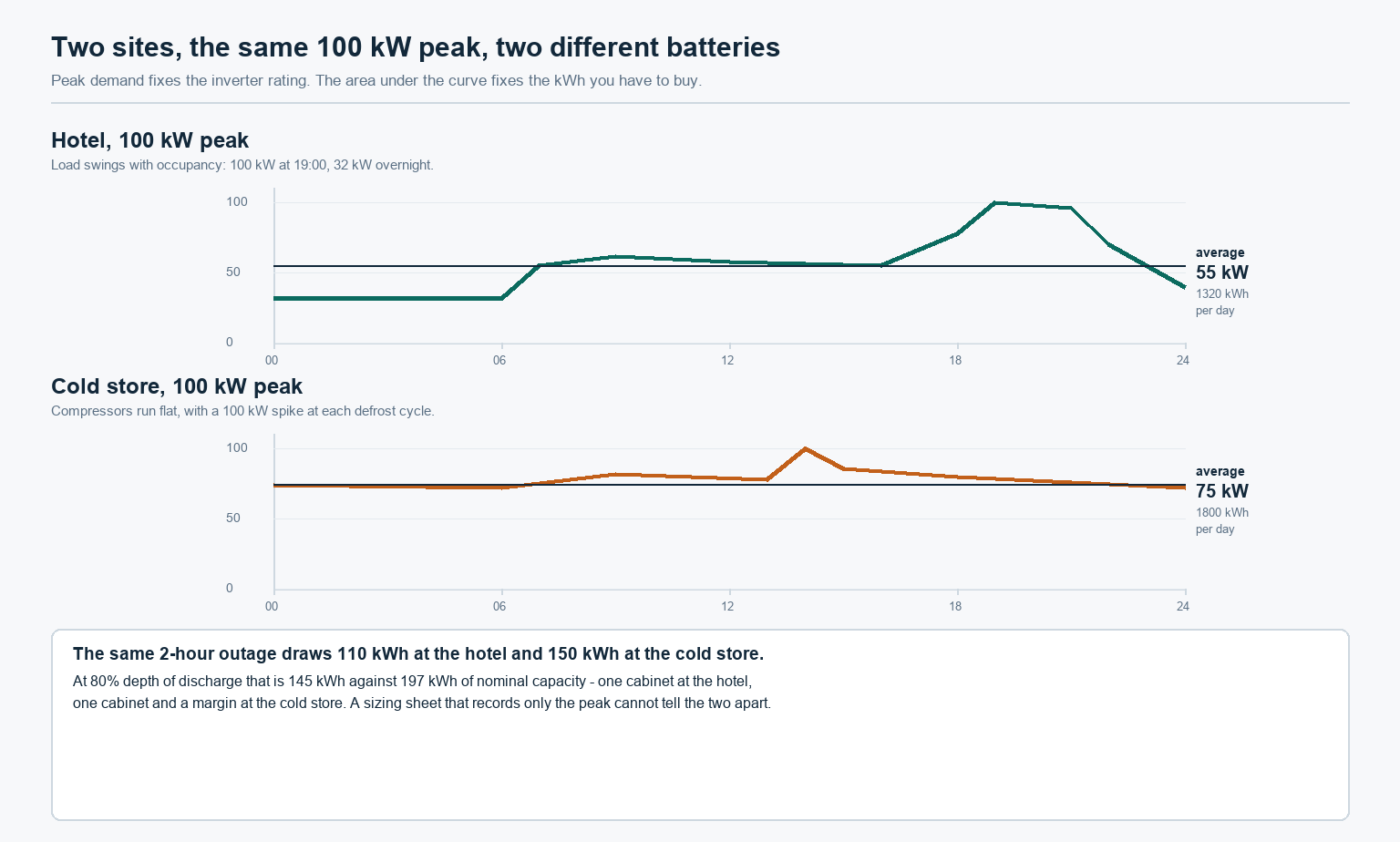
The load profile chart below is the clearest argument against a peak-only battery storage sizing 100kw sheet. Both sites peak at 100 kW. The hotel averages 55 kW and the cold store averages 75 kW, and over a two-hour outage that is 110 kWh against 150 kWh. After the 0.76 divisor it is 145 kWh against 197 kWh of nameplate.
The hotel lands on one 215 kWh cabinet with room to spare. The cold store lands on the same cabinet with almost none, and a four-hour outage pushes it to two cabinets. Nothing in the peak figure predicted that battery storage sizing 100kw difference; only the shape of the day did.
This is why the same 100 kW quotation can be right for one buyer and 40% short for another, and why a battery storage sizing 100kw proposal that arrives without a load profile is a guess with a price attached. Ask for the profile before the price.
The load side of the same question is worked through in our guide to what a 100kW/215kWh system can actually power, and the wider method for sizing a whole solar-plus-storage installation is in the commercial solar sizing guide.
Sizing in your market
The battery storage sizing 100kw formula does not change by country. What changes is the outage you design for and the bill you are trying to move, and those two variables move the kWh number more than any equipment difference.
| Market | Commercial tariff, USD/kWh | What drives the kWh figure |
|---|---|---|
| Philippines | 0.156 | Typhoon-season outage length; demand charge on the utility bill |
| Nigeria | 0.049 | Diesel displacement, not bill savings; grid outages of four hours and more |
| Ghana | 0.175 | Load shedding schedule and the net metering application |
| Kenya | 0.171 | Supply reliability plus the licence conditions on the installation |
| Panama, Costa Rica | 0.198–0.255 | Demand charge and outage cover in the same battery |
| Bahamas, Cayman, Barbados | 0.326–0.370 | Demand charge, because the tariff is high enough to pay for peak shaving |
| Oman, UAE, Bahrain | 0.090–0.156 | Outage ride-through and diesel avoidance; savings alone rarely justify it |
| Qatar, Saudi Arabia | 0.036–0.053 | Diesel avoidance at remote sites only |
The market column is where battery storage sizing 100kw stops being arithmetic and becomes a design decision.
In the Philippines the binding constraint is usually the length of a typhoon-season outage, which is a multi-hour design case rather than a one-hour one. A 100 kW site that wants eight hours of cover needs 100 × 0.65 × 8 ÷ 0.76 = 684 kWh, which is three cabinets and a different budget. A battery storage sizing 100kw answer for Manila is therefore rarely a one-cabinet answer. Tariffs shown are commercial rates compiled in December 2025.
Nigeria inverts the battery storage sizing 100kw logic. At 0.049 per kWh, grid electricity is cheap enough that bill savings rarely pay for a battery, so the design case is the diesel generator and the outage it replaces. Sizing then follows the hours the generator would otherwise run, and the diesel saving is the payback. Solar yield matters too: Lagos averages 3.63 kWh per kWp per day against 4.71 in Jos, so a Lagos system needs more PV for the same daily energy.
Ghana and Kenya sit between the two. Both have tariffs high enough for peak shaving to make sense and grids unreliable enough for outage cover to matter, so the same battery does two jobs and the battery storage sizing 100kw question becomes which job sets the kWh. In Ghana the answer is usually the outage; in Kenya it is often the demand charge.
Across Central America and the Caribbean the tariff does most of the work. At 0.37 per kWh in the Bahamas, shifting a 100 kW peak off the demand charge can justify a battery on its own, and the outage cover comes free with the capacity already bought. Battery storage sizing 100kw in the islands is a demand-charge calculation first. In the Gulf the same battery is harder to justify on savings, because industrial tariffs of 0.036–0.156 leave little to shave; there the case is a remote site, a diesel generator and the cost of not running it.
For country-level numbers rather than method, start from the Nigeria, Philippines, Ghana and Kenya market pages. Each carries the local tariff and outage context that battery storage sizing 100kw has to be fitted to.
What each size costs
In battery storage sizing 100kw, capacity is priced per kWh, and the band we publish for CIF Lagos is $140–185 per kWh. On that basis a 215 kWh cabinet is $30,100–39,800 for the battery, and a 430 kWh installation is $60,200–79,550. The figures are CIF, so freight and insurance to the port are inside them and duty is not.
A complete system costs more than its battery. The 100kW / 215kWh system we build, including the PCS, the energy management controller, switchgear, enclosure and freight, is $88,000–115,000 CIF. The gap between that and the $30,100–39,800 battery line is the power conversion and the balance of plant, which is why a 100 kW site cannot be priced from a per-kWh storage number alone. That gap is the first thing a battery storage sizing 100kw budget has to separate.
Two consequences follow for battery storage sizing 100kw. First, the marginal cost of the second cabinet is close to the storage band, because the PCS is already bought; doubling from 215 to 430 kWh adds roughly $30,000–40,000 rather than doubling the system price. Second, oversizing the battery is cheaper than oversizing the inverter, so where the choice exists, add kWh before kW.
The battery storage sizing 100kw CIF bands for 50, 100, 200, 500 kWh and 1–2 MWh are collected in our resources section, and the per-kWh build-up is in the battery storage cost guide. Prices move with cell pricing and freight, so treat the bands as a budgeting range and the quotation as the number.
Five ways a sizing sheet ends up 30% too big
Oversizing is the common failure in battery storage sizing 100kw, and it is rarely caused by the formula. It is caused by what goes into it. These five inputs account for most of the excess capacity we see in proposals that reach us for a second opinion.
- Connected load used instead of measured demand. The sum of every nameplate on the board is typically 1.5–2 times the real maximum demand, because diversity is real.
- Peak held for the whole outage. A 100 kW peak that lasts twenty minutes does not need to be carried for four hours at 100 kW.
- No load factor in the battery storage sizing 100kw sheet. Assuming the site runs at its peak all day doubles the energy estimate without anyone noticing.
- Depth of discharge ignored, so the usable kWh is assumed to be the nameplate kWh.
- Existing diesel ignored. A site with a working generator needs the battery to cover the gap until it starts, not the whole outage.
Each of those inflates the battery storage sizing 100kw answer by 20–100% on its own, and they compound. A sizing sheet that carries all five can easily propose 430 kWh for a site that needs 215 kWh, and the buyer pays for a second cabinet that never cycles below 60% depth of discharge.
The correction is not a smaller safety factor. It is better inputs: twelve months of maximum demand, a week of interval data, a stated outage duration, and a decision about what the diesel is for. Those four items are the whole of battery storage sizing 100kw, and none of them comes from a catalogue. None of the five failures above is a battery problem; all of them are battery storage sizing 100kw problems.