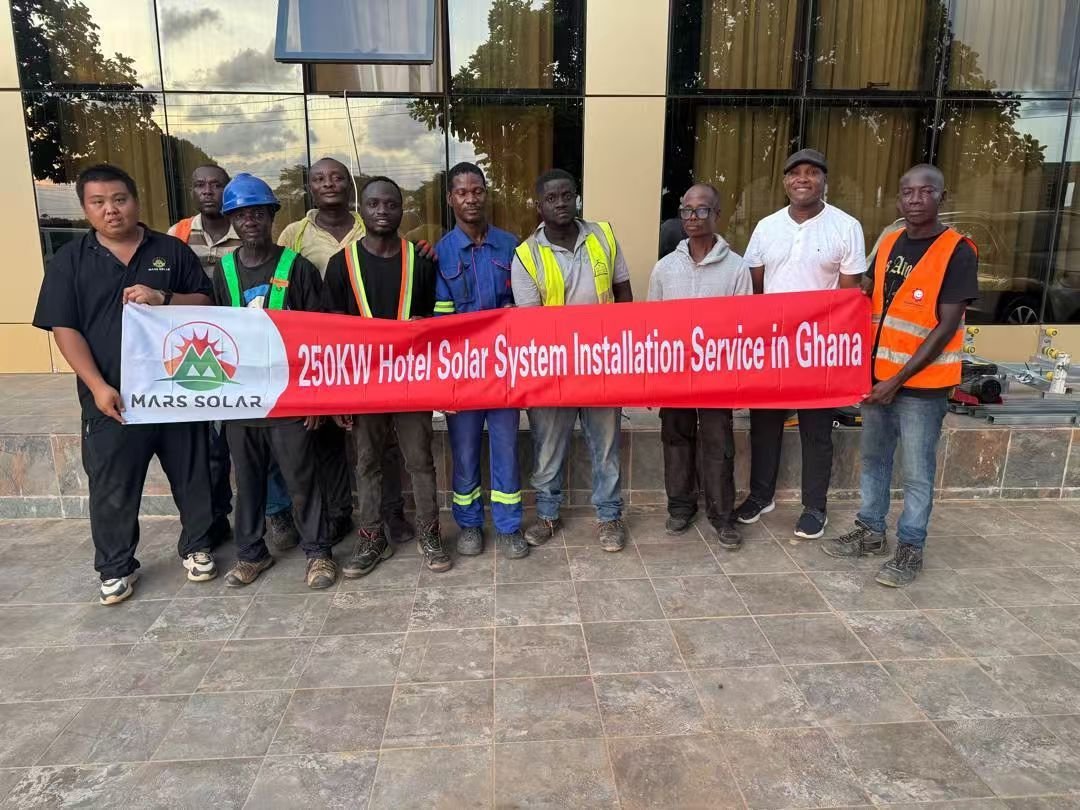
A hotel is one of the hardest commercial buildings to solar-size and one of the easiest to underserve. Guests expect cold rooms, hot showers and working air conditioning at 21:00, long after the array has stopped producing. This guide walks through how we designed a 250kW rooftop with storage for a Ghana hotel — the load profile, the 2026 PURC tariff, the incentive stack and the payback arithmetic — using photos from our own installation crew.
Ghana Hotel Solar Starts With the Load Audit, Not the Roof
Two hotels with the same room count can run very different loads. What matters is the shape of the curve, not the star rating. In practice we ask for twelve months of bills, the generator fuel log and a walk-through of the plant room before we put a single module on a drawing.
A tropical hotel's daytime load is dominated by cooling, followed by laundry, kitchens and pool plant — all of it running while the sun is up. That alignment is why hotels convert solar energy into bill savings so efficiently: most of what the array produces is consumed on site at the moment it is produced, which is worth far more than exporting it.
The evening is the hard part. Guest-room loads, façade and garden lighting, and entertainment areas peak after sunset. That is the job of the battery bank — and the reason a hotel benefits from storage more than a pure daytime factory does.
What the 2026 PURC Tariff Change Means for Your Bill
Ghana's Public Utilities Regulatory Commission cut electricity tariffs by an average of 4.81% in its Second Quarter 2026 review, effective 1 April 2026. These are the rates businesses actually pay ECG:
| Customer category | From 1 Apr 2026 | Before |
|---|---|---|
| Non-residential, 0–300 kWh | 177.75 GHp/kWh | 180.76 GHp/kWh |
| Non-residential, 301+ kWh | 216.49 GHp/kWh | 224.64 GHp/kWh |
| Special Load Tariff, low voltage | 232.11 GHp/kWh | 269.77 GHp/kWh |
| Special Load Tariff, high voltage | 182.12 GHp/kWh | 215.34 GHp/kWh |
Two things follow from that table. First, a mid-size hotel consuming above 300 kWh still pays 216.49 pesewas per kWh — about GHS 2.16, or roughly $0.19 at the 11.19 cedi/dollar rate the PURC used for the quarter (216.49 ÷ 100 ÷ 11.1931 = $0.1934). Second, hotels usually land on the Special Load Tariff once they cross into LV supply, where the low-voltage rate is 232.11 GHp — about $0.21. Cheap by Caribbean standards, still far above the cost of solar produced on the roof, and an order of magnitude below diesel.
The direction of travel matters as much as the level. Tariffs fell this quarter because the cedi strengthened and inflation cooled; they rose 9.86% at the start of the year under the same Multi-Year Tariff Order. A system designed only against today's rate is a bet on currency stability. One designed against diesel displacement is not.
The Incentive Stack: Duty Relief, VAT and Capital Allowances
We covered the import paperwork in detail in our Ghana solar system cost guide — 0% duty on panels under HS 8541.43, inverters typically 0–5% and batteries 10–20% depending on classification, with VAT treatment having changed several times since 2023. The short version: confirm current rates with a licensed clearing agent before you budget, and make sure the commercial invoice matches the packing list, because mis-declared equipment is the number-one cause of clearance delays at Tema.
Two further levers are worth raising with your accountant. Industry compliance guides report that Ghana allows accelerated capital allowances on renewable-energy assets — 50% in year one and 25% annually thereafter — and that a net metering scheme remains active with annual settlement (SurgePV, 2026). Both are reported figures rather than advice: confirm the current treatment with your tax adviser and your utility before you model them into the business case.
Worked Example: What a 250kW Rooftop With Storage Actually Returns
Here is the arithmetic we run, with every input labelled so you can swap in your own numbers.
| Step | Figure | Where it comes from |
|---|---|---|
| Annual yield, 250kW in Accra | ≈ 375,000 kWh/yr | Derived: 150,000 kWh/yr per 100kW (our Ghana cost guide, 4.8–5.0 peak sun hours) × 2.5 |
| Self-consumed on site | ≈ 262,500 kWh/yr | Assumption: 70% (derived) — hotel daytime load matches production |
| Value if displacing grid only | GHS 568,286/yr ≈ $50,800 | 262,500 × GHS 2.1649 ÷ 11.1931 (derived) |
| Value if displacing diesel | $73,500 – 118,100/yr | 262,500 × $0.28–0.45 (diesel range from our Ghana cost guide) |
| Blended (60% diesel / 40% grid) | $64,300 – 91,100/yr | 0.6 × diesel + 0.4 × grid rate (derived) |
| System cost, CIF | ≈ $200,000 – 255,000 | Interpolated between our published anchors: 100kW+215kWh at $88k–115k and 500kW+1MWh at $390k–480k; (250−100)÷(500−100) = 37.5% |
| Landed cost (+20–35%) | ≈ $240,000 – 345,000 | Derived from the CIF range above |
| Payback | ≈ 2.6 – 5.4 years | $240k ÷ $91.1k to $345k ÷ $64.3k; mid-case ≈ 3.8 years |
The spread is the point. If your hotel runs generators long hours because of outages or power quality, the system pays for itself at the diesel end of the range — usually inside three to four years. If the grid is reliable where you are and you only want to cut the ECG bill, expect closer to five. Both are defensible; pretending the spread does not exist is not.
What Gets Installed: the Reference Configuration
This is the specification we design to for a hotel at this scale — the actual bill of materials is always confirmed against the site's load audit.
| Solar panels | 400 × 625W N-type TOPCon (250kWp), 23% efficiency |
|---|---|
| Inverters | 3 × hybrid units, three-phase, 380/400/415V output |
| Battery storage | 500kWh LiFePO4 in outdoor cabinets, 6,000+ cycle rating |
| Mounting | Anodised aluminium rails rated for 55 m/s wind, metal-roof clamps |
| Protection | DC combiner boxes with surge protection, AC distribution |
| Monitoring | Remote platform with production and alarm reporting |
| Warranty | 25-year panel power warranty · 10-year inverter · 5–10-year battery |

The battery room is the part most quotations gloss over. Cabinets need ventilation, clearances for service access, and a fire-rated separation from guest areas. On this project the bank sits in its own plant room, which also shortens the DC runs and keeps cabling off the roof.
Installation Reality: Four Weeks on a Ghana Roof

Metal roofs make the mechanical work fast and the detailing critical. Rails are fixed to the purlins with the correct clips, every penetration gets sealed, and the array is stepped around roof penetrations, water tanks and plant equipment rather than over them.

Strings are tested before they are closed up, torque values are checked with a calibrated tool, and the whole array is commissioned against the single-line diagram — not against a sales deck. Hotels add one more constraint that factories don't: the work happens around guests, so noisy tasks are scheduled into the low-occupancy windows and roof access is controlled.

Indoor work runs in parallel: inverter and battery rooms, protection panels and the monitoring link. Handover includes as-built drawings, a test report and a walk-through with the hotel's own maintenance team.