
Quick answer: hotel solar battery backup
A hotel solar battery backup should be sized from the outage you are insuring against, not from the tariff you are arbitraging. In 2026 the pattern that works for most properties in our markets is a hybrid system where the array carries daytime load and the battery carries a named list of loads — guest room air conditioning, kitchen cold storage, front desk and POS — for four to eight hours. Sizing to named loads rather than the whole property typically keeps storage inside the 35–50% share of system cost that commercial budgets expect, while still covering everything a guest would notice.
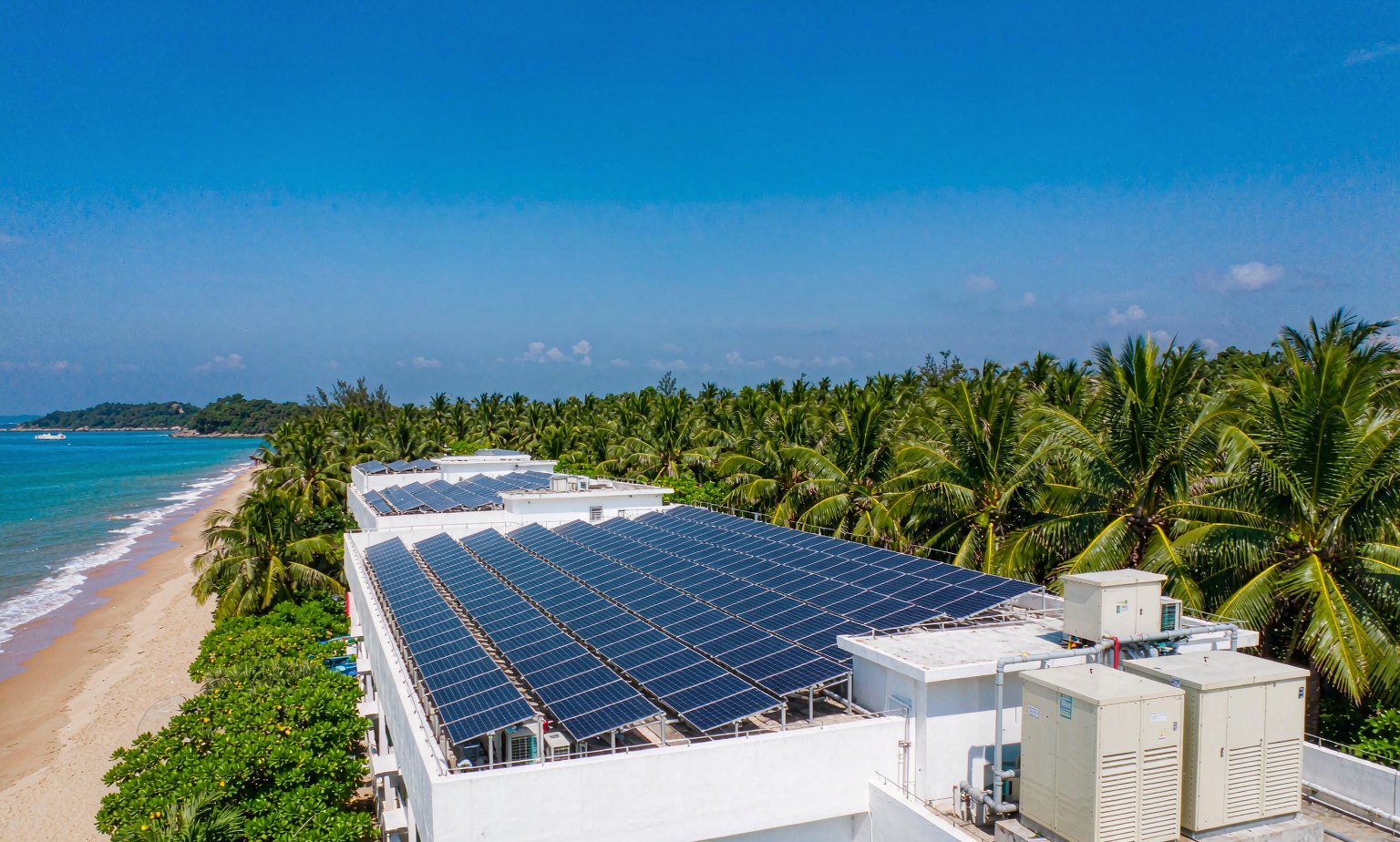
Images on this page are illustrative renders rather than photographs of a specific client installation. The as-built figures in the tables come from our own project files.
What one outage actually costs a hotel
Two costs follow every outage that a hotel solar battery backup could have prevented, and only one of them appears on that month's P&L.
Direct cash. Refunds and room comps, spoiled cold storage, lost food and beverage revenue, laundry that cannot run, staff overtime for manual check-in, and the diesel your generator burns.
The cost that never appears as a line item. A night without air conditioning in a tropical market produces one-star reviews. Those reviews sit on the booking platforms for years and move both your occupancy and your achievable rate. Most hoteliers we work with can name that number informally even when it is not in the budget — and a point of review score is worth more than a year of diesel.
Here is the direct-cash side worked out with inputs you should replace with your own. Assume a 60-room property at 70% occupancy and $90 average daily rate, and one six-hour evening outage:
| Cost line | How to estimate it | Illustration |
|---|---|---|
| Refunds and room comps | Rooms you comp × ADR | 8 rooms × $90 = $720 |
| Food and beverage revenue lost | Outage hours × typical evening F&B take | $700 |
| Cold storage spoilage | Kitchen and bar stock at risk | $350 |
| Generator fuel | Backed-up kW × hours × $0.28–0.45/kWh | 75 kW × 6 h = 450 kWh → $126–203 |
| Staff overtime and manual operations | Extra front-desk and engineering hours | $200 |
| Total direct cash, one evening | ≈ $2,100–2,170 |
Run that across a year of outage evenings and it stops being a rounding error. It is also the number any hotel solar battery backup has to beat on payback. The frequency is what changes by market, which is why the sizing table further down is split by country rather than given as a single global figure. Replace every input above with your own — the arithmetic is the part that transfers, not the illustration.
One caveat is worth stating plainly. Hotel solar battery backup economics do not work on tariff arbitrage in most of our markets. At $0.049/kWh in Nigeria or $0.036/kWh in Qatar there is almost nothing to arbitrage. The battery is bought for continuity, and the model has to be built that way or it will not survive contact with your finance director.
How many hours of backup each load tier needs
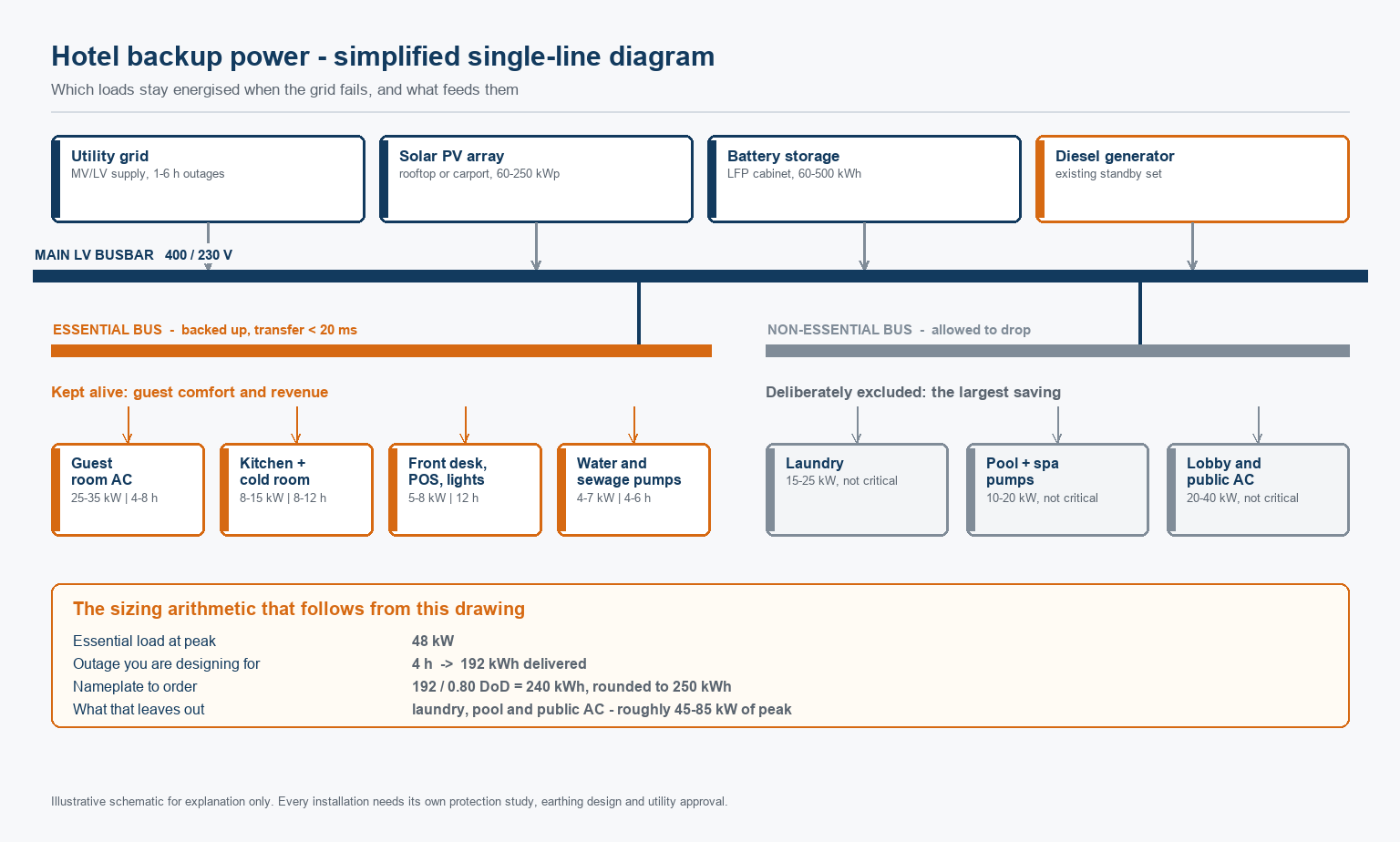
The fastest way to overspend on a hotel solar battery backup is to size for the whole property. A hotel has two very different kinds of load, and only one of them needs a battery in front of it:
| Load tier | What it covers | Typical kW, 60-room property | Hours to design for | Why |
|---|---|---|---|---|
| Guest room AC and lighting | Room splits or central AHU, corridor and room lighting | 25–35 kW | 4–8 h | This is the product. A guest who cannot sleep does not rebook. |
| Kitchen cold storage | Walk-in freezers, chillers, bar fridges | 8–15 kW | 8–12 h | Food safety and stock value, and the longest continuous run |
| Front desk, POS, IT, lobby | Reception, card terminals, Wi-Fi, back office | 5–8 kW | 12 h or to generator handover | Check-in and payments cannot stop |
| Water pumps and borehole | Pressure pumps, treatment | 4–7 kW | 4–6 h | No water is as visible to a guest as no air conditioning |
| Laundry | Washers, dryers, ironers | 15–25 kW | 0 h | Deferrable — run it tomorrow |
| Pool pumps and filtration | Circulation, heating | 5–10 kW | 0 h | Deferrable — guests notice a cloudy pool far less than a warm room |
Add up the hours you actually committed to, multiply by the kW in each tier, and you have the kilowatt-hours the battery must deliver. Notice what falls off a hotel solar battery backup: laundry and pool plant are often 20–30 kW of a property's draw and contribute nothing to guest-perceived continuity. Dropping them is usually the single biggest saving available in a hotel solar battery backup design.
The backup arithmetic, with the two derates people forget
Runtime = usable battery kWh ÷ backed-up load kW
The same arithmetic fixes the size of any hotel solar battery backup. Applied to the tiers above: commit to guest rooms at 30 kW, cold storage at 12 kW and front desk at 6 kW, and the backed-up load is 48 kW. A 120 kWh usable bank gives 120 ÷ 48 = 2.5 hours. A 215 kWh bank at 80% depth of discharge gives about 172 kWh usable, which is 3.6 hours at the same load — or roughly 5.7 hours if you shed the kitchen after the first two.
Two derates catch people out in almost every hotel solar battery backup we design, and both are cheap to get right at design stage and expensive to fix on site:
- Usable is not nameplate. A 215 kWh bank at 80% depth of discharge delivers about 172 kWh. Read the usable figure on the datasheet, not the marketing number.
- AC compressor inrush. Air conditioning can draw two to three times running current for a second or two on start. Size the inverter's continuous and surge rating against the whole island panel, not just the steady-state kW. A 60 kW chill plant on a 50 kW inverter island is a design error that no amount of extra battery capacity fixes.
Our commercial solar sizing guide walks the full load-to-kilowatt-hour sequence if you want the longer version of this arithmetic.

Diesel versus battery: the generator is idle capital
Every hotel we visit already has a generator, and the objection to a hotel solar battery backup is always the same — why buy a battery when the genset works? There are two answers for a hotel solar battery backup, one financial and one technical.
Financially. Diesel generation lands around $0.28–0.45 per kWh once fuel, maintenance, filters and allocated overhaul are counted. That is consistent with published generator fuel charts, which put prime-power diesel at $0.30–0.50 per kWh in fuel alone before any maintenance is added. A battery block, by contrast, delivers stored energy at roughly $0.032–0.043 per kWh across its warranty life — the throughput arithmetic is worked line by line in our battery storage cost per kWh guide. On the energy itself that is a multiple of seven to thirteen.
But the more important point is utilisation. A standby generator runs perhaps 100–200 hours a year. For a hotel solar battery backup, capital that only works one to two per cent of the time is expensive capital. The same battery does tariff arbitrage, peak shaving and solar self-consumption across the other 8,600 hours — which is why the payback on hotel storage is usually driven by what it does on ordinary days, not on outage days.
Technically. A generator starts in 10–30 seconds and needs an automatic transfer switch. A hybrid inverter transfers in under 20 milliseconds — fast enough that guests do not see lights flicker or lifts stop. For a hotel that difference is close to the whole point, because the event you are really insuring against is often two seconds long, and the generator never even starts for it.
Sizing hotel solar battery backup by market
The right hotel solar battery backup is market-specific, because what it has to survive changes with the grid:
| Market | Outage pattern | What it pushes the design towards |
|---|---|---|
| Philippines | Generally stable on mainland Luzon; island and resort sites see scheduled and unscheduled interruptions; typhoon season brings multi-day outages | 4–8 h on guest comfort; wind-rated mounting and an export arrangement agreed with the distribution utility. Tariff detail is in our Philippines solar system price guide |
| Nigeria | Frequent short interruptions — our Nigeria architecture guide works from 8–12 per day on some feeders | Daily cycling, so cycle life matters more than hours per event; 2–4 h plus solar self-consumption is usually the economic answer |
| Kenya / Ghana | Less frequent and more often scheduled; Ghana has seen episodic load-shedding periods | 4–6 h. Commercial tariffs around $0.171 and $0.175/kWh make self-consumption worth modelling alongside backup |
| Caribbean | Rare but long — hurricane-driven, multi-day, with the grid down across an island | 8–12 h plus a specified generator handover. See our hurricane-resistant solar guide |
| Middle East | Very reliable grid; the driver is self-consumption and cooling load, not outages | 2–4 h. Prioritise high-temperature behaviour — see solar panels in Middle East heat |
Tariff figures: GlobalPetrolPrices, December 2025. Outage patterns are drawn from our own project records and should be re-checked against your utility's published interruption history before you commit capital.
What a resort installation actually looks like
Our Palawan resort project is the pattern most hotel solar battery backup projects in our markets end up with: 60 kW of PV with 120 kWh of storage, deliberately sized to carry air conditioning, cold storage and POS rather than the whole property. The as-built numbers:
| Metric | As built |
|---|---|
| System | 60 kW array + 120 kWh battery storage |
| Monthly electricity bill | ₱145,000 down to ₱25,000 — an 83% reduction |
| Simple payback | 15 months |
| Installation window | 5 days on site |
| Backup scope | Air conditioning, cold storage, POS systems |
| Grid arrangement | Export capped — zero-export to the feeder |
| Storm record | Commissioned in early 2023; rode out Typhoon Egay in July 2023 with zero damage on a wind-engineered roof attachment |
Two things in that hotel solar battery backup file are worth copying. First, the hotel solar battery backup scope was a named-load design — exactly the tier approach above — which is why 120 kWh was enough rather than the 300 kWh a whole-property design would have demanded. Second, the 15-month payback is far faster than a grid-tariff model predicts, because an island site's effective cost of power runs well above the $0.156 grid anchor once diesel blending and outage losses are counted. The same hardware pays back faster where the grid is weakest.

What a hotel solar battery backup quote must state
Seven items belong in every hotel solar battery backup quote, all of them cheap to specify and expensive to discover later:
- Usable kWh at a stated depth of discharge. Not nameplate. A 215 kWh bank at 80% DoD delivers about 172 kWh.
- Transfer time, in milliseconds. Under 20 ms is the threshold at which guests do not see lights flicker or lifts stop. Ask for the measured figure, not "seamless".
- Which circuits sit on the backed-up panel. Insist on a single-line diagram before signature, so the scope is a drawing rather than a conversation.
- Surge capability. Continuous and peak discharge power, checked against AC compressor inrush rather than steady-state kW.
- Cycle life and term, together. 6,000 cycles at 80% DoD or 10 years, whichever comes first.
- Enclosure and cooling. Air cooling is standard on cabinet systems up to 261 kWh; liquid cooling earns its cost on containerised systems from 500 kWh, where cell temperature spread is held within 2°C.
- What is excluded. Switchgear, civil works, permits and the generator integration — the line items most likely to move after signature.
FAQ: hotel solar battery backup
How many hours of hotel solar battery backup do I actually need?
Should the battery cover the whole hotel?
Is a 215 kWh battery enough for a hotel?
Why not just run the generator we already own?
Will guests notice the switch to battery?
Does hotel solar battery backup pay back on tariff savings?
What happens to air conditioning when the grid fails?
How long do hotel batteries last?
Do I need liquid cooling for a hotel system?
Where can I see what a full hotel system costs?
Get a backup design for your property
Send your room count, your outage history and a list of what must stay on when the grid drops, and we will return a hotel solar battery backup design with the load tiers, the usable kWh, a landed cost and a payback range — usually within 24 hours.