
Cold storage is the best-load-shape business in the country for solar and one of the worst to quote. The load runs 24 hours and peaks in the afternoon, which is ideal; but the bill is driven as much by peak kilowatts as by kilowatt-hours, and the system has to survive brownouts that would otherwise spoil inventory. This guide covers solar power for cold storage in the Philippines from the compressor cycle outward, using real installations we have commissioned.
Planning a project in the Philippines? Our commercial solar Philippines guide covers typhoon-rated specification, net-metering rules and a worked 100 kWp + 215 kWh payback at local tariffs.
Three things separate a cold store from an office building with the same electricity bill.
The load never stops. Compressors, condensers and evaporator fans run through the night. That is unusually good for solar economics: a system sized to the daytime slice of this load is consumed entirely on site, so there is no export, no curtailment and no dependence on a net-metering credit arriving on time.
The peak falls in the afternoon. Compressor duty rises with ambient temperature, so the heaviest draw lands in the warmest part of the day — close to when the array peaks. Businesses that peak after sundown pay a demand charge solar cannot touch; cold stores do not, at least on the energy side of it.
The cost of being wrong is inventory. In a warehouse a brownout costs an hour of production. In a cold room it can cost the stock. That changes what the system is for: it is not only an electricity-saving device, it is insurance, and the battery is priced accordingly.

Most Philippine solar content is written for households, where the bill is almost entirely per kilowatt-hour. Commercial billing inverts that above 5kW of demand. Meralco’s published July 2026 schedule (VAT-exclusive), for the General Power class that most cold stores fall into, splits the bill like this:
| Charge | Amount | Billed on |
|---|---|---|
| Generation | ₱9.2504 /kWh | Energy |
| System loss | ₱0.8751 /kWh | Energy |
| Distribution (energy) | ₱0.1339 /kWh | Energy |
| Energy subtotal, net of adjustments | ₱10.1355 /kWh | Energy |
| Transmission | ₱427.97 /kW | Peak demand |
| Distribution (demand) | ₱232.20 /kW | Peak demand |
| Demand subtotal | ₱660.17 /kW | Your single highest sustained draw |
Read those last three rows twice. A cold store pulling 150kW at its worst moment pays about ₱99,000 a month in demand charges before a single kilowatt-hour is priced — and that charge follows the peak, not the average. This is why a solar quote built on kilowatt-hour savings alone overstates the return, and why start-up sequencing matters: staggering compressor and chiller start-up shaves the billed peak at zero capital cost, before solar enters the conversation.
For context, an Ember analysis of Department of Energy data put Philippine commercial electricity at ₱11.7 per kWh in March 2026 — the second highest in Southeast Asia after Singapore. One more lever arrived in 2026: the Energy Regulatory Commission lowered the retail contestability threshold to 100kW effective 26 June, so mid-sized cold stores can now buy generation from a Retail Electricity Supplier. That is complementary to solar rather than a substitute, and the two should be evaluated together.
A cold store is not sized from floor area or from the nameplate on the compressor. Five steps, in order:
Worked properly, the array follows a load curve rather than a rule of thumb — which is also why two quotes for the same building can differ by 40%. The general method is set out in our commercial sizing guide.
The honest way to price a battery for cold storage is to start from the event it prevents. Thermal mass buys time — a full, closed cold room drifts slowly — but door traffic, product entering warm and ambient heat all shorten it, and the compressor has to recover the loss afterwards.
That produces two very different battery sizes, and both are legitimate:
Either way the chemistry and the inverter behaviour matter more than the kilowatt-hour figure on the label: LFP cells rated for 6,000+ cycles at 80% depth of discharge, an integrated BMS with temperature protection, and an inverter that accepts a generator on the AC input for the days when neither sun nor battery is enough.
Cold storage sits in the favourable half of the Philippine commercial solar market, for one structural reason: self-consumption is close to 100%. The load runs at night as well as by day, so everything the array produces during daylight displaces a purchased kilowatt-hour. There is no export to time, no curtailment, and no dependence on a net-metering credit.
The cost side uses the same reference points we publish across our 2026 quotes:
| Cost factor | Typical figure (2026) |
|---|---|
| Solar modules | $0.28–0.48 per watt FOB, tier-1 supply |
| Sea freight & clearing to Manila | Typically +20–35% over FOB |
| Storage share of total cost | 35–50% where batteries are included |
| Verified reference: 100kW + 215kWh | $88,000–115,000 CIF |
| Verified reference: 500kW + 1MWh | $390,000–480,000 CIF |
For a size between the two references, build the number rather than interpolate. Take a 150kW array with a 300kWh cabinet, which is a common cold-chain configuration:
Against the energy subtotal above, every self-consumed kilowatt-hour saves about ₱10.14 — before fuel-cost pass-through increases, which have arrived three billing months in a row in 2026. Full 2026 price tables by system size are in our Philippine price guide.
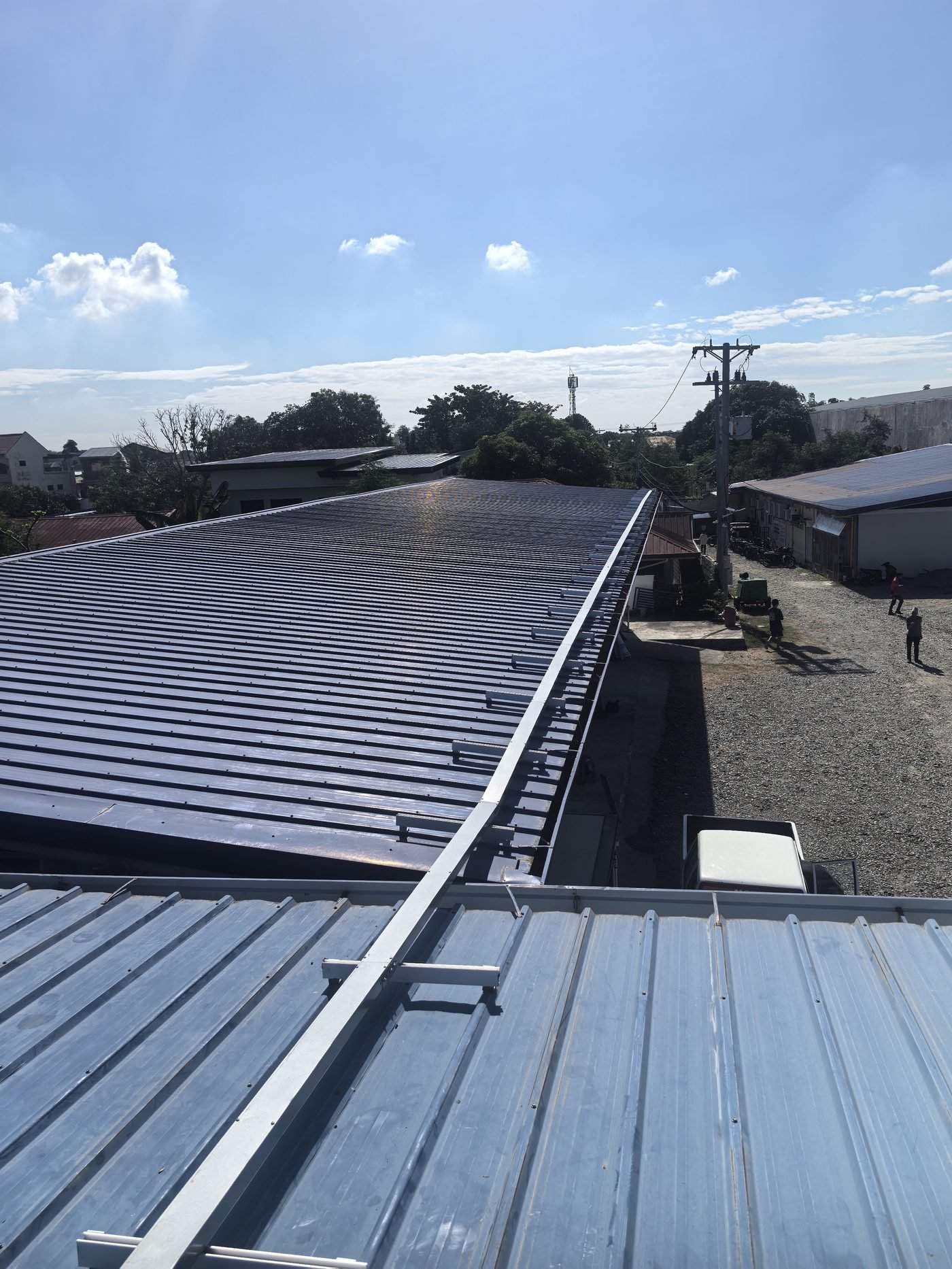
Three of our Philippine cold-chain installations, photographed on site during commissioning and survey.


Tariff line items are from Meralco’s published Summary Schedule of Rates effective July 2026 billing, VAT-exclusive, General Power class. The regional comparison is an Ember analysis of Department of Energy data as reported in May 2026. The retail contestability threshold change took effect 26 June 2026. Cost ranges are Mars Solar 2026 quotes; the storage unit range is derived from our shipped-and-cleared reference projects and shown with its arithmetic.
Free system design and ROI estimate within 24 hours — based on your actual electricity and fuel bills.